Over many years of bushwalking in Australia I have come to appreciate the eucalypts more and more. Instead of seeing just gum trees, that constant dull green background, I have grown aware of the diversity of these trees from the giants of over 100 feet, wide and shady to the dense thickets of mallee, smooth or rough barked, the ever changing varieties of colour of the trunks, the weird shapes that branches can form and of course, that ever-present myrtle scent.
I would like to share with you some of the interest to be gained from being able to identify them.
There are over 600 varieties in Australia[1], of which 60 are found naturally in South Australia. I would like to draw your attention to about 14 that can be found in our Adelaide Hills and the Lower Flinders Ranges on walks. There are many different characteristics which can help to identify a particular tree:
- the general size and shape
- the growth pattern of the trunk or trunks
- the bark
- the size, shape, colour and vein patterns of the leaves
- the colour and shape of young leaves
- the place where the tree is growing
- the final test is the size, shape, and growth patterns of the flower buds and fruits, the so-called gumnuts.
Often you cannot reach the buds or fruit on a tall tree, so a search on the ground will usually reveal some, because eucalypts are untidy trees which continually litter the ground with leaves and twigs.
Retaining their gumnuts over much of the year allows us to identify them over a longer period. A pair of binoculars is also helpful for looking into the taller trees.
It is worth noting that there has been widespread planting of trees from other states, especially those with showy flowers or curious fruits. Perhaps the best known is the red flowering gum, Eucalyptus ficifolia of W.A.
These plantings can often be recognised around obvious places like parks, public buildings, streets and property boundaries and also country roadsides, but often as several mixed varieties. There is also one conspicuous example of a tree from a small area of S.A. being planted extensively elsewhere. Eucalyptus cladocalyx, the sugar gum is now widespread, especially seen around farms in lines and often showing the pollarding signs. About 1916 the government offered a bounty to all farmers who planted trees. Apparently the seeds of E. cladocalyx germinated very easily and were readily available.
It certainly is a strong grower, provides useful timber and looks a good tree.
To identify the eucalypts and talk about them, it is obvious that their names will have to be used frequently. I have heard many people complain over the use of long latin names, why not use common names which are easy to remember? People have tried applying common names to Australian plants but they are never completely successful. A blue gum of S.A. is the yellow gum of Victoria, the messmate of Victoria is the stringy bark of S.A. and the name stringy bark is given to several different trees. Sydney’s blue gum is E. saligna, Tasmania’s blue gum is E. globulus, and S.A.’s blue gum is E. leucoxylon. If you refer to Eucaluptus citriodora, everyone in the world who is interested in trees will know which one you mean, and the latin is often a useful description of a distinguishing characteristic of the tree[2]. By the way, the Eucalypts belong to the family MYRTACEAE which also includes the bottle brushes and tea trees of Australia and the garden myrtles of Europe.
A method of broadly defining and classifying the eucalypts was devised in the middle of last century by Baron von Mueller, by lumping groups of trees into bark types. The two major groups are the trees, those with one main trunk, usually tall or thick or both, and the mallees, those with numerous slender stems all arising from one root.
The trees can then be divided according to their bark types:
- the ‘gums‘ with smooth, pale bark which flakes or peels off either continually or as in most cases, annually – often summer
- the ‘boxes with dark, hard or flaky bark which doesn’t peel
- the ‘stringy barks‘ with dark, furrowed, fibrous bark extending to the branches
There are other bark groups such as iron barks, bloodwoods and peppermint barks, but I will deal with the former three. These groupings are a very helpful guide in narrowing the field of search for identity but there are too many confusions for bark type to be a conclusive test of the species of a eucalypt[3]. Some of the stringy barks, for example have smooth bark when they are saplings, such as E. obliqua.
The seedling leaves are another useful guide in ‘finding’ the species of gum. Often some species of eucalypts which in their adult form of leaf are extremely difficult to separate, separate quite easily when comparing their juvenile leaves.
‘Juvenile’ leaves, come as seedlings or after damage to the tissue, such as by fires. They are often a broader shape than adult leaves, often horizontal, some of the lower leaves in pairs compared to adults’ alternate leaves, and some are bluish green in colour. The leaves contrast so strongly with the adult foliage especially on E. goniocalyx that you could think there are two trees. The young leaves actually help the tree to grow rapidly either in its youth or after damage from fires, because of the colour of the leaf and its horizontal angle help to trap sunlight for photosynthesis.
THE GUMS: RED, BLUE AND PINK
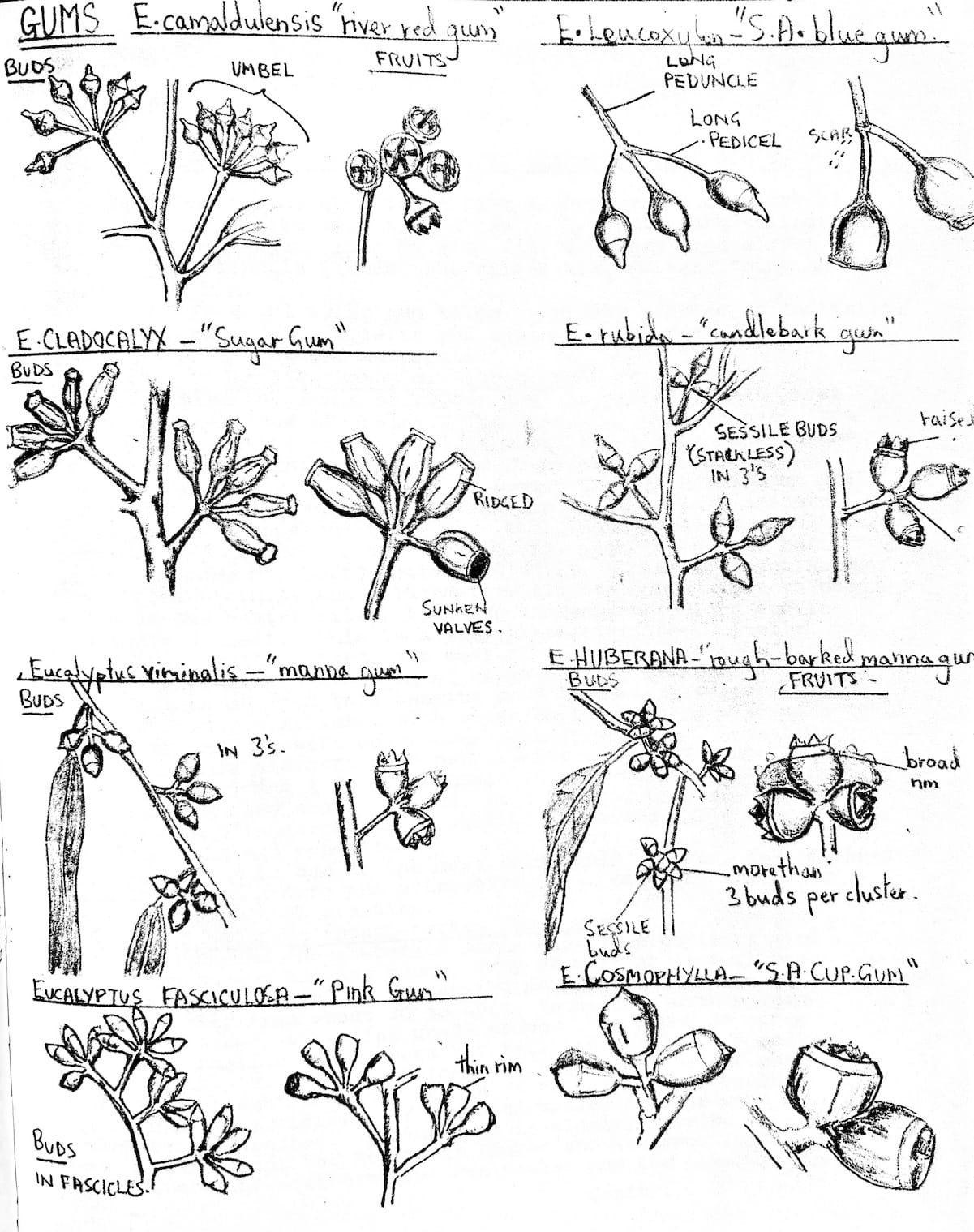
Eucalyptus camaldulensis The River Red Gum
Probably the most well known tree in Australia, and well known in many parts of the world is Eucalyptus camaldulensis, our river red gum. The botanical name is derived from the Camalduli, a religious order which first cultivated seedlings of this species in 1830[4], and the common name refers to the dark red coloured timber of the riverine species. A lot of common names seem to derive from those early settlement days in Australia when gum trees had such timber value.
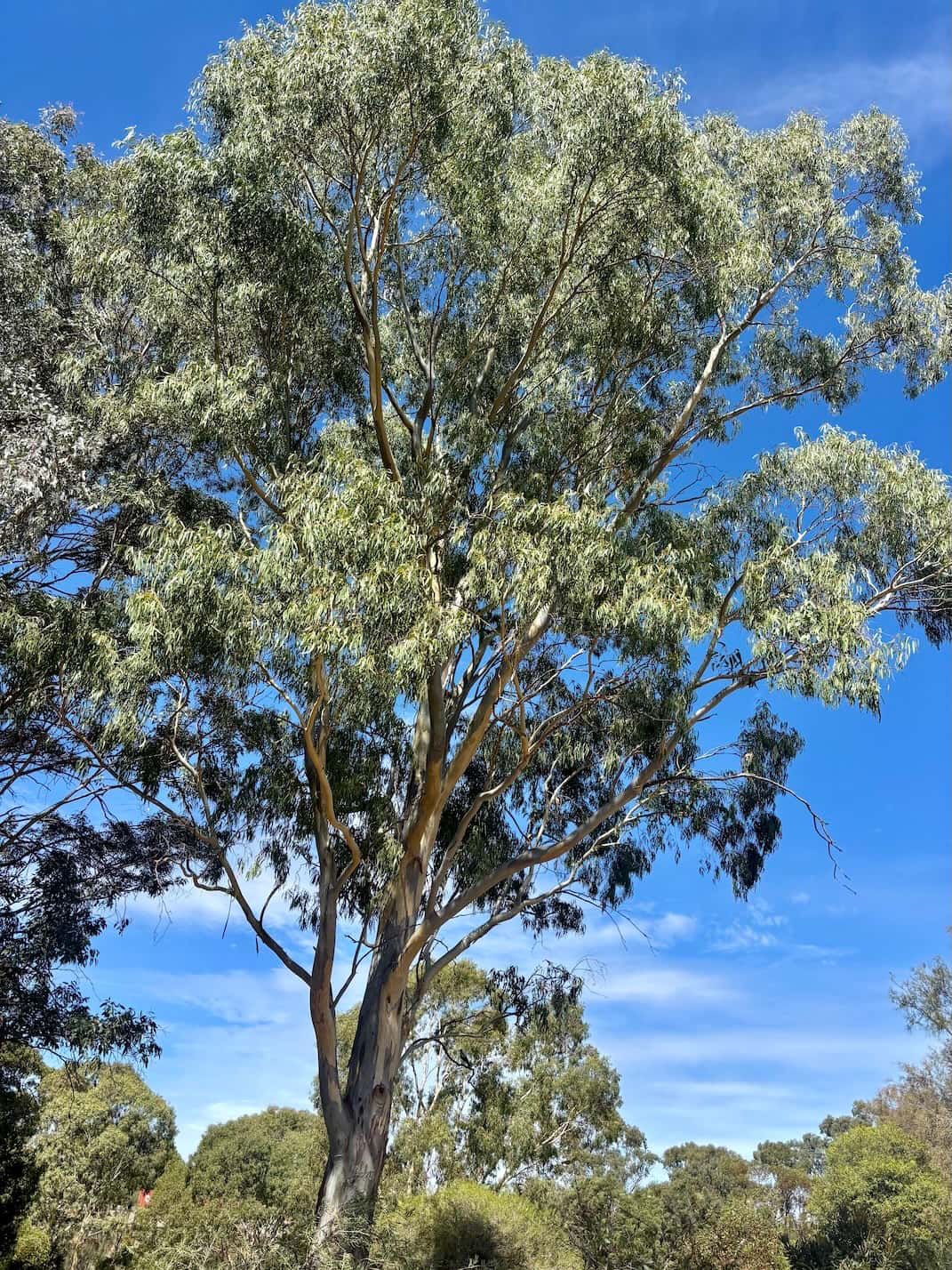
Around the city of Adelaide the most conspicuous eucalypts will be trees with pale bark, greyish, or almost white, blotched and marked with darker greyish or bluish patches and streaks. Some will have rough, dark bark extending some distance up their trunks from the ground. Closer examination will show these trees are either Eucalyptus camaldulensis or E. leucoxylon (the S.A. blue gum). In the old trees river red gums often retain a low scarf of bark, especially after the summer shedding of bark higher up the tree.
This summer shedding comes through the sap flow diminishing at that time to the bark.
At first sight these two trees can appear very similar but E. camaldulensis often has smaller leaves and a softer general appearance[5]. E. camaldulensis has a broad spreading crown supported by a robust trunk, with a few thick, very curved and even crooked branches, supporting a thin covering of foliage.
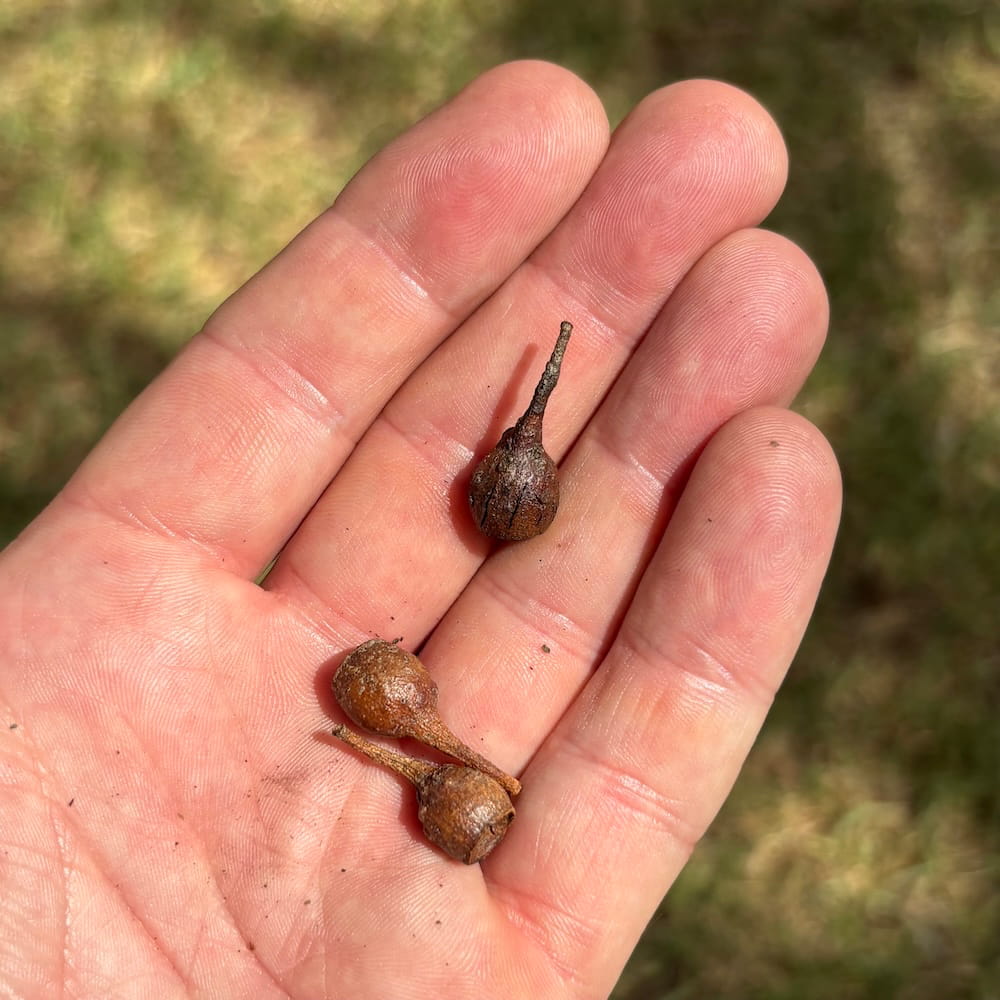
The buds and fruits of E. camaldulensis and E. leucoxylon are the quickest means of identifying the two gums which occur together so often in the lower foothills and valleys. From a distance one can often notice the larger flower buds of the S.A. blue gum which are on a long peduncle, subtending three lemon like buds on long pedicels (stalklets). If the caps are off, large flowers can be seen, mostly white to light pink, but occasionally some trees are dark red; these are the forms from which nurserymen often look to obtain seed. The hullaballoo that can be heard at the tops of the trees at this time of the year is good evidence that the rosellas are on to a good thing[6].
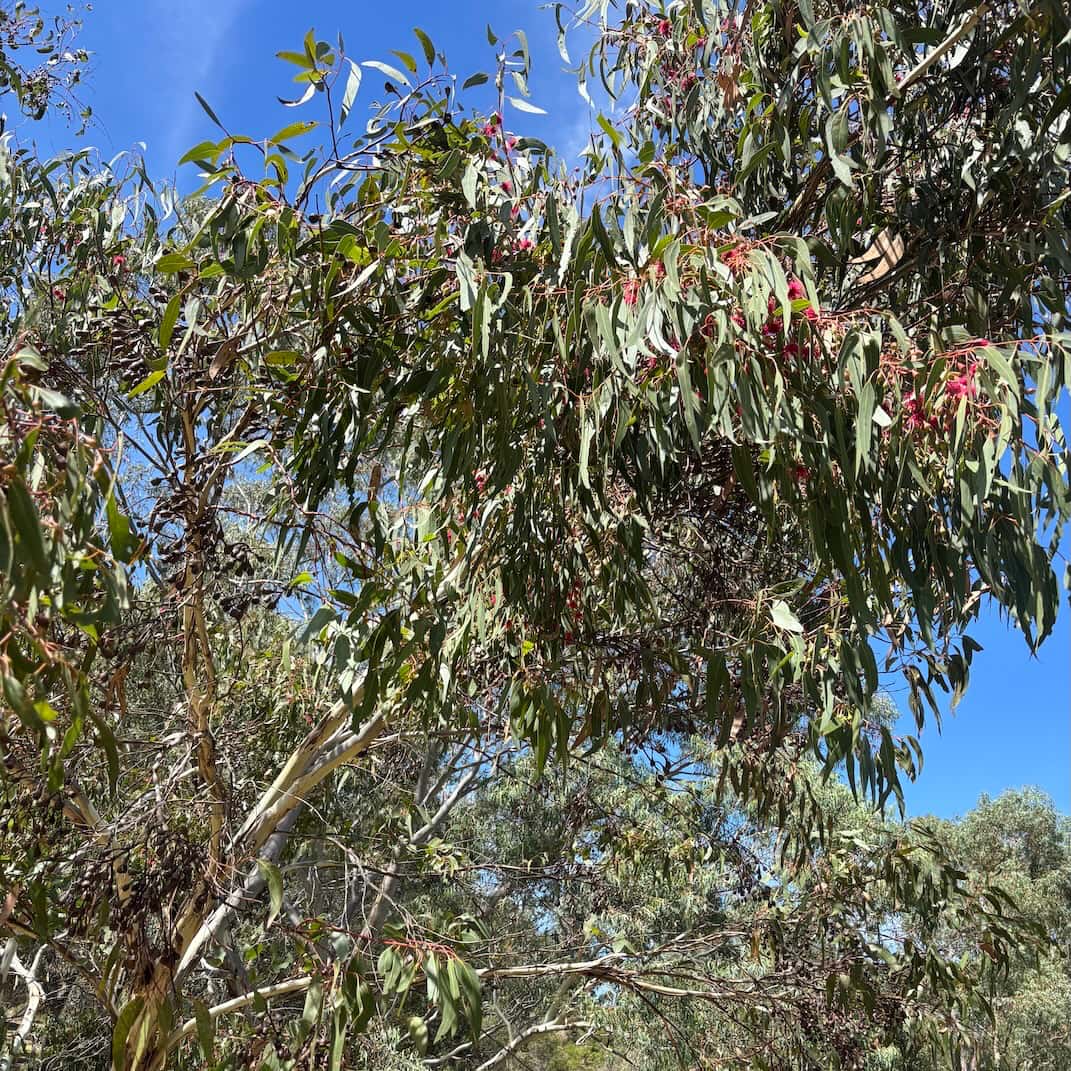
The buds of E. camaldulensis on the other hand are small and numerous (5-14) and are arranged like spokes of a wheel with pointed little bud caps. It has masses of little white flowers, which are a good honey source.
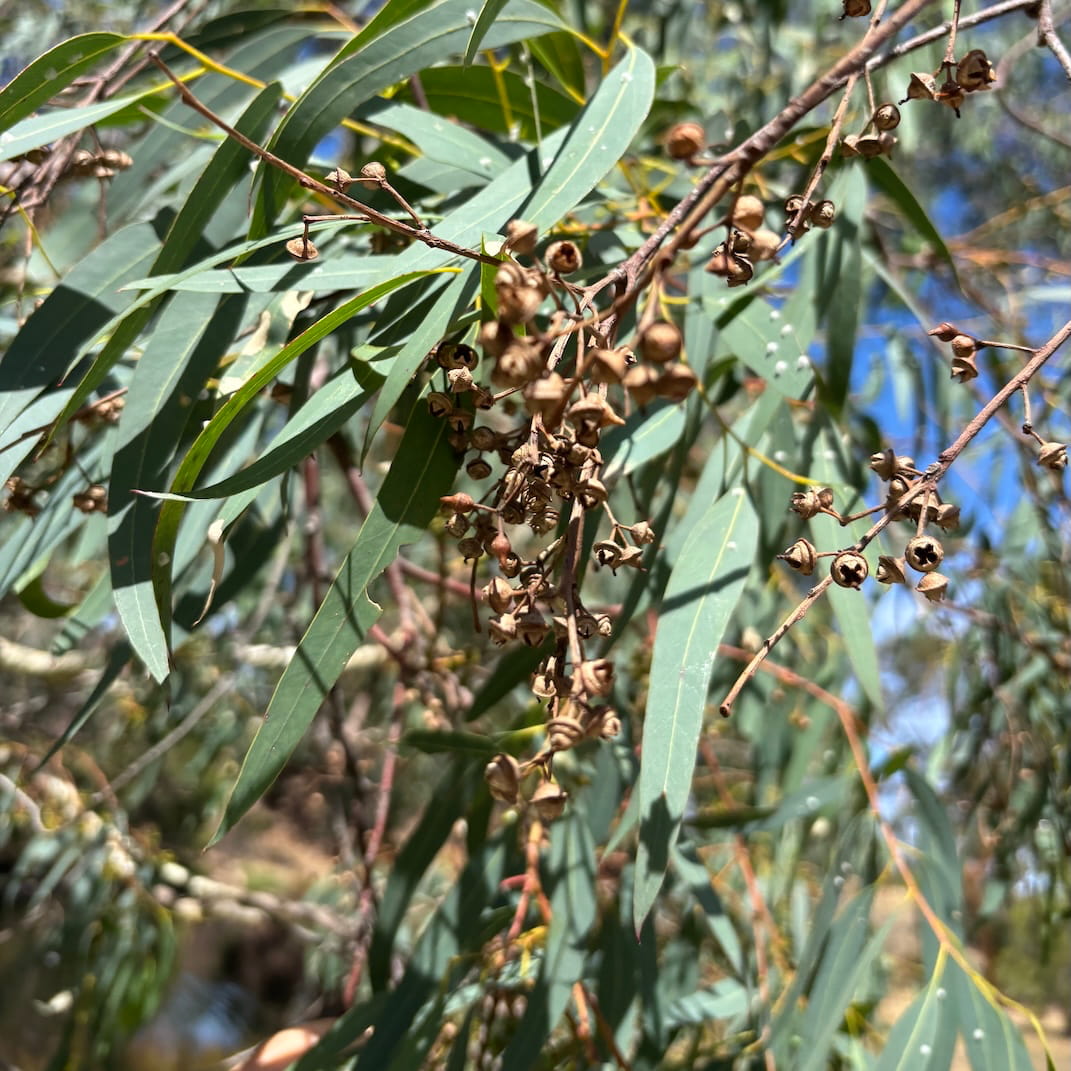
The fruits of river red gum are typically small and round, with stout, triangular and distinctive protruding valves, whereas the blue gums fruits are large, hemispherical to ovate (egg-shaped) with the valves set below rim level.
These trees can be found all round the eastern suburbs of Adelaide at Morialta, Magill, Burnside, Mitcham and whereever creeks come out of the hills. As you progress north through the Flinders, you will see dark lines of E. camaldulensis marking the courses of the creeks winding towards the gulf or the salt lakes. Only in the far north is it replaced by other species.
In the top end of the Flinders Ranges you will see a beautiful intense blue foliage form of the river red gum in the red gorges and also the bud caps are more rounded than the pointed buds further south. It extends from the valleys into the hills of the Mt. Lofty Ranges where the rain is over 23″ [580mm] and the soils are a fertile acid silt-loam. For example, I have seen largish trees at 1100ft. [335m] around Anstey’s Hill.
River red gum is very adaptable, from sandy to heavy soils, it is drought and frost resistant and can withstand periodic inundation. It is extremely fast growing and can reach 60ft in 10 years in the semi-arid areas. The usefulness of river red gum as shade, highway planting, ornamentals, timber, or windbreaks is confirmed by its being the most widely planted eucalypt in the world.
Eucalyptus leucoxylon The SA Blue Gum
E. leucoxylon is also widely distributed, strongly represented in north central Victoria, western N.S.W. and S.A. to Pt. Augusta. The S.A. Blue Gum grows on heavier shallow clay soils and is quite common in the undulating foothills of the Adelaide Hills and Lower Flinders up to Pt. Augusta. The botanical name comes from the greek for ‘white wood’ while the common name refers to the bluish-green seedling leaves (which often help in the recognition of this tree). In open woodland it is a small to medium tree up to 60 ft high, but on moist valley sites can develop into a tall erect tree of 100ft.
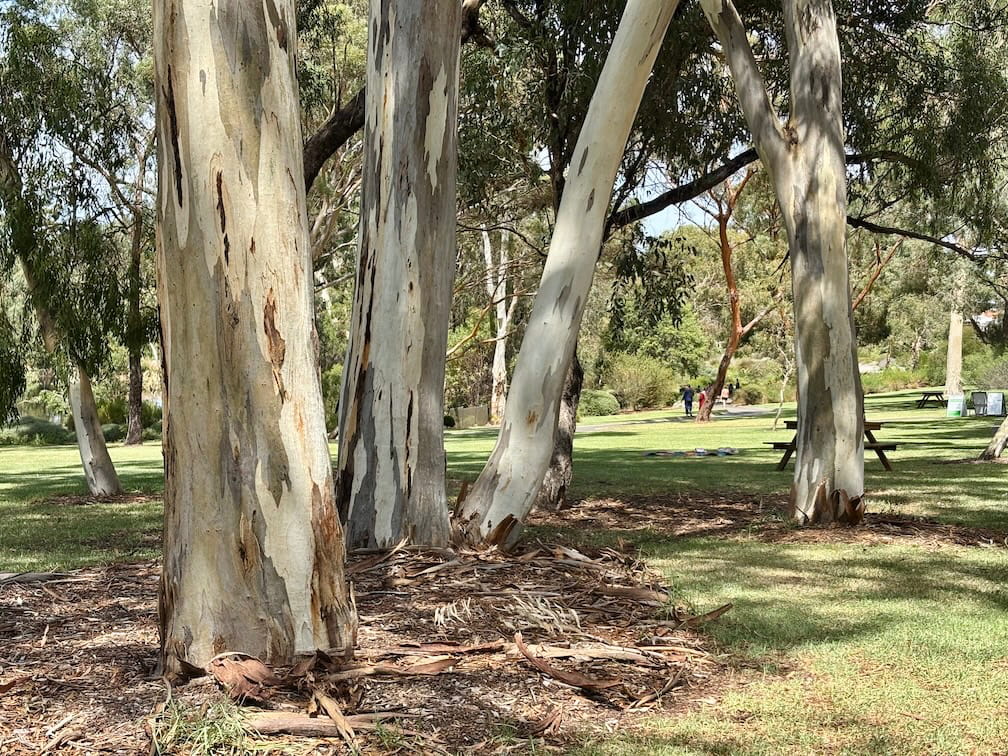
Eucalyptus fasciculosa Pink gum
A third gum which is quite common in the Adelaide Hills within the 15-30″ [380-760mm] rainfall area is E. fasciculosa, the Pink or Hill gum.
Pink gum, so named because of the pinkish-coloured timber, commonly occurs on rocky ridges, invariably a stunted and crooked tree to 15ft. high. The botanical name refers to the concentration of the many buds into large branched clusters (fascicles). This tree can grow into quite a handsome specimen at times on the deeper soils.
They seem to be found mainly on the north and west (exposed) sides of hills. Several western spurs of Ansteys Hill Scrub overlooking Tea Tree Gully are comprised of mainly pink gums, as largish trees, mixed with blue gums and an occasional red gum in the depressions and lower levels, but the pink gum quickly becomes more stunted on the steep slopes to the ridge top, where there is an obvious change to the long-leafed box, E. goniocalyx, growing over the South and Eastern spurs.
E. fasciculosa thrives on sandy soils such as at Aldinga scrub and there are some fine specimens along the Melbourne road near Tintinara and Keith, also it is common on Kangaroo Island and in the S.E. of S.A. into Victoria.
These trees have thick, white patches of grey and slaty blue-barked trunks topped by heavy, twisted limbs. It retains variable amounts of rather rough brown bark mainly at the base of the trunk, sometimes higher and often patches near branch junctions.
The rather sparse thick leaves are usually of a dull, greyish green and droop sideways so that pink gums never give a dense shade.
You can quickly identify this tree from a distance when it is in bud or flowering, for the whole of the outside perimeter of the tree is covered with these many-branched clusters of tiny club-shaped buds or white flowers[7].
The fruit is small and pear-shaped to cylindrical, having a thin rim with small valves below rim level.
E. fasciculosa produces a hard, strong timber which can be used for posts, rails and firewood. It is a useful honey-producing tree because it often flowers after the blue gum has finished, thus extending the season.
Eucalyptus cladocalyx The Sugar Gum
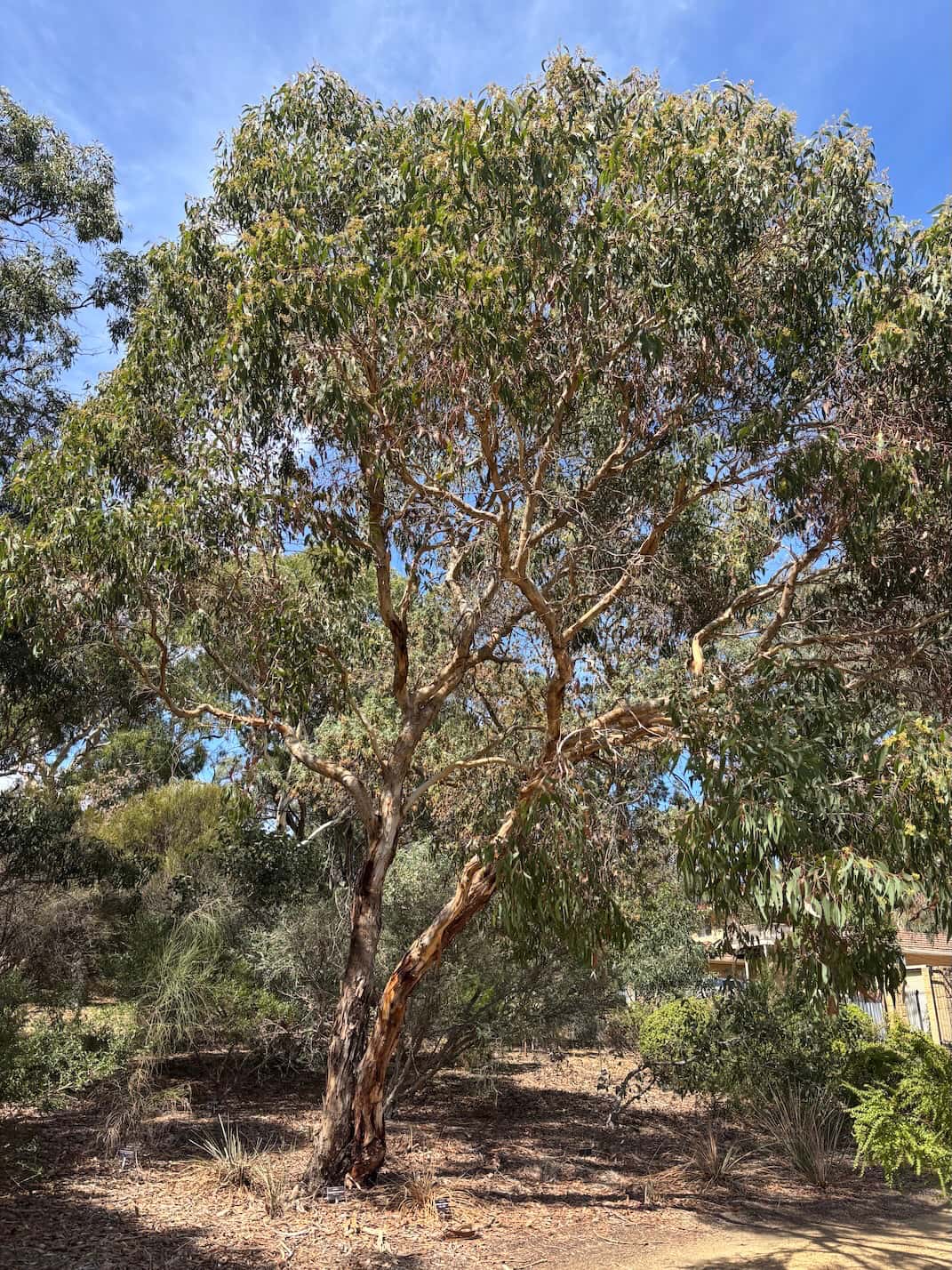
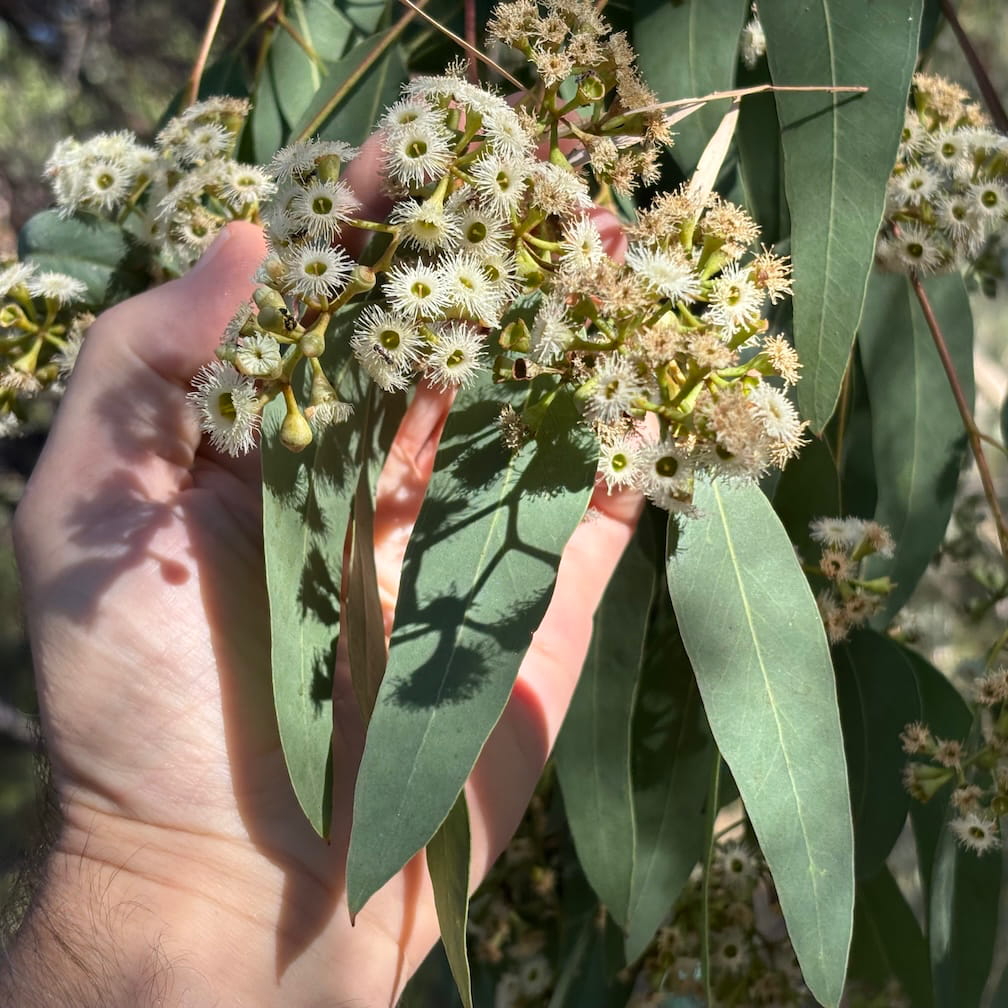
E. cladocalyx the sugar gum comes from 3 widely separated areas in S.A. and nowhere else. It needs acid soil and a rainfall of about 22 inches [560mm] and these reguirements are met in the North of Kangaroo Island, in the Lower Eyre Peninsula, on Marble Range and in the Southern Flinders Ranges between Crystal Brook and Mt. Brown. There is a dwarf spreading form on Kangaroo Island, but normally it is an upright tree to 60ft, on Eyre peninsula it is a small and crooked tree but in the southern Flinders it is an imposing tree to 100ft. There are some beautiful specimens in Alligator Gorge National Park[8] and near Telowie Gorge. Its name of sugar gum is due to sheep and cattle liking the young sweetish foliage, while the scientific name comes from the twig-like appearance of the immature buds. One can quite easily pick the colour and form of E. cladocalyx above mallee trees eg. on Blacks Hill, Mambray Creek after the track passes E. odorata. It has dark, coppery green, largish lance shaped leaves which often glint in the distance. The unique clumping of the adult foliage at the ends of the branches gives a storied umbrella effect, obvious from a distant view.
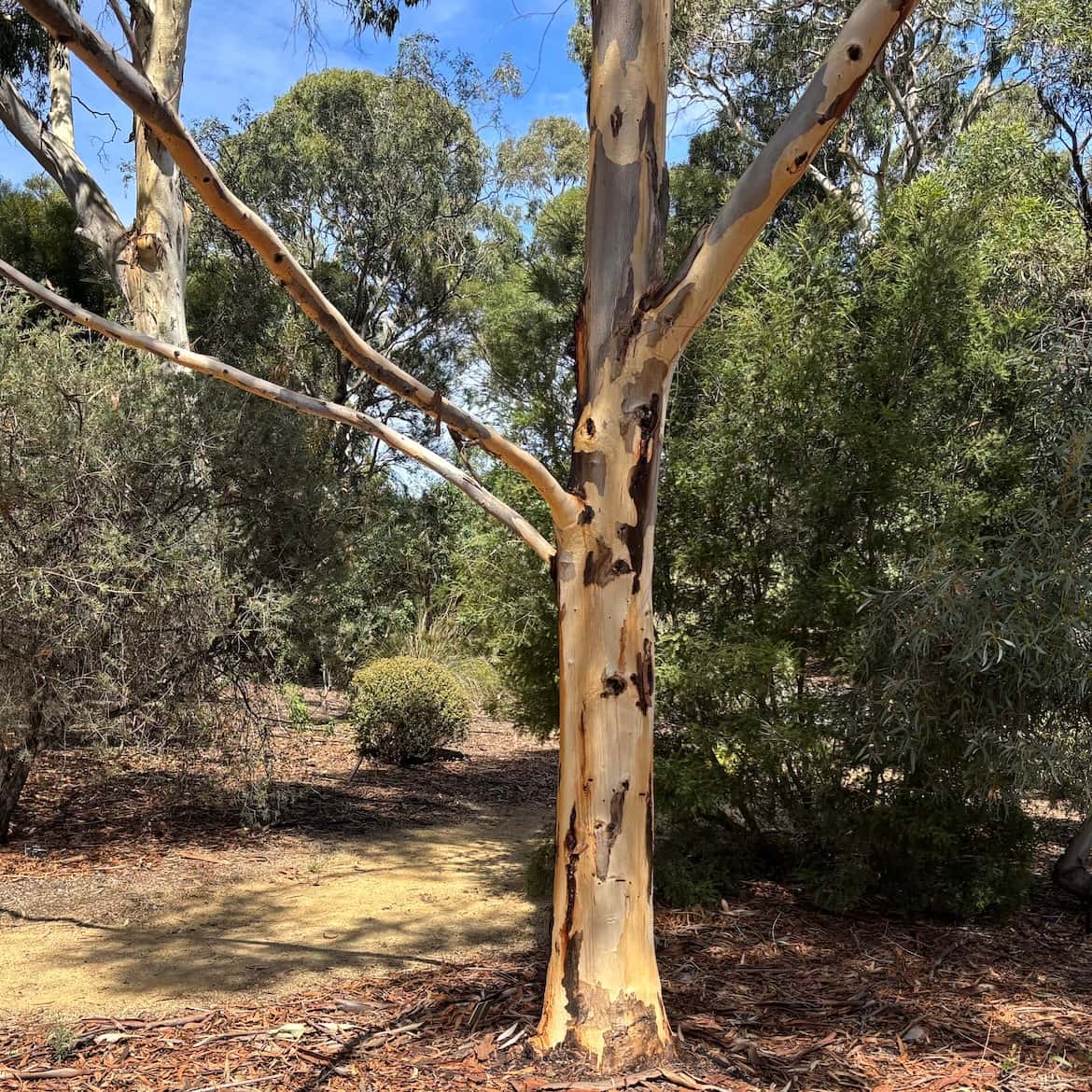
The bark is deciduous as in all gums; with the result that the bark is not uniform in colour but blotched and streaked the large trunks look beautiful after rain, like a patchwork quilt of colour. The colour is basically a palish yellow or sometimes amber, which makes it different to a lot of the neighbouring trees. It is also grey, off white, and slaty blue due to the periodic shedding of old bark in large flakes.
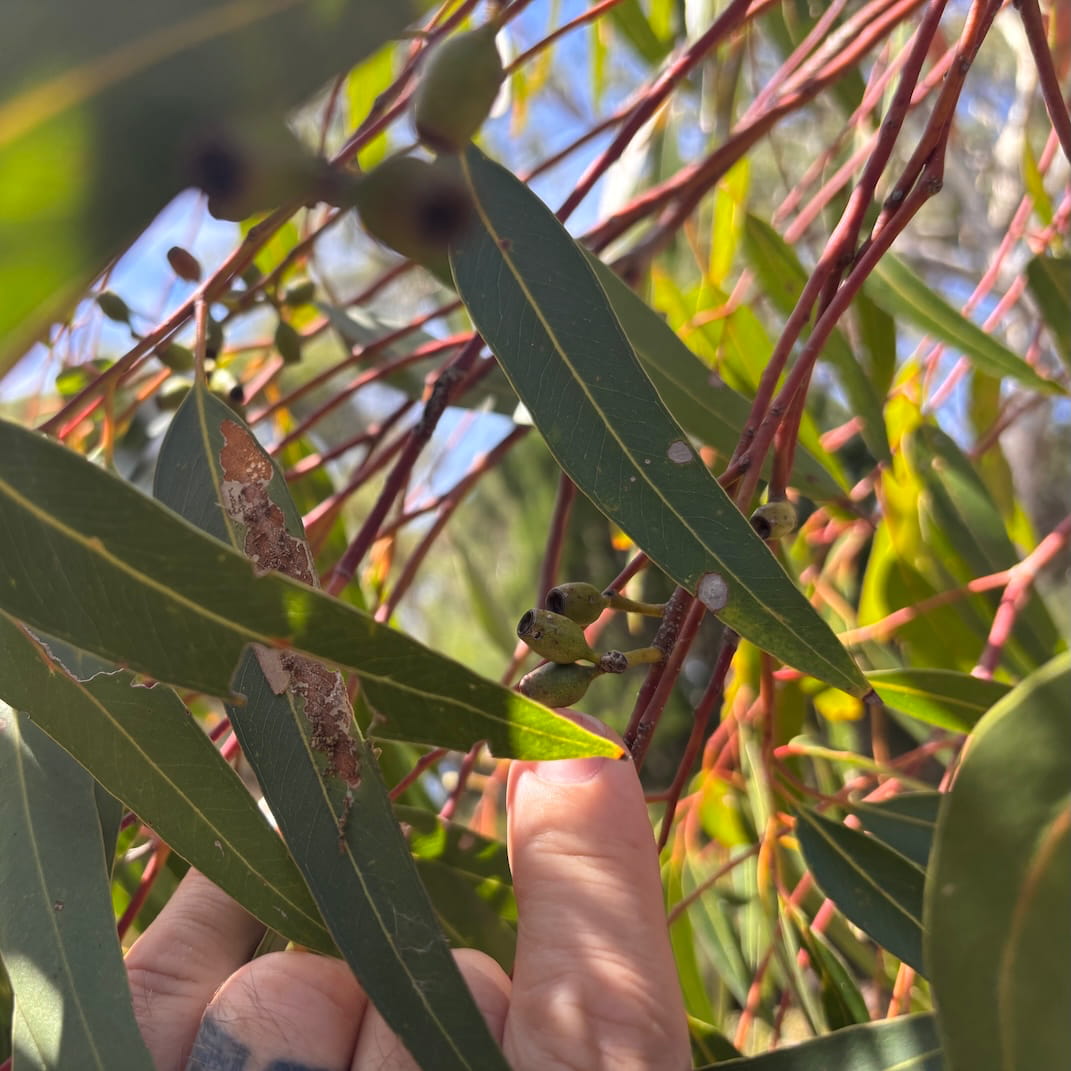
The flower buds are distinctive – they are in clusters of 4-16, very much like urns with a cap. The fruits are cylindrical to urn-shaped 1-1.5cm. long by 1cm. and vary from almost smooth to distinctly ribbed, the valves are set well below the constricted rim.
Apart from the sugar gum being so widely planted in Australia, it was introduced to Morialta and has naturalised at about 1000ft. near the second waterfall.
Eucalyptus viminalis Manna or Ribbon Gum
E. viminalis manna or ribbon gum is probably best known as the popular food of Koalas. The botanical name derives from the pendulous habit of the foliage while the common name refers to the edible secretions which are found on the upper bark of the tree in summer. Manna gum is common on cool moist deep soil and steep slopes, especially in eastern Victoria, and eastern Tasmania but also along the N.S.W. tablelands to the Queensland border.
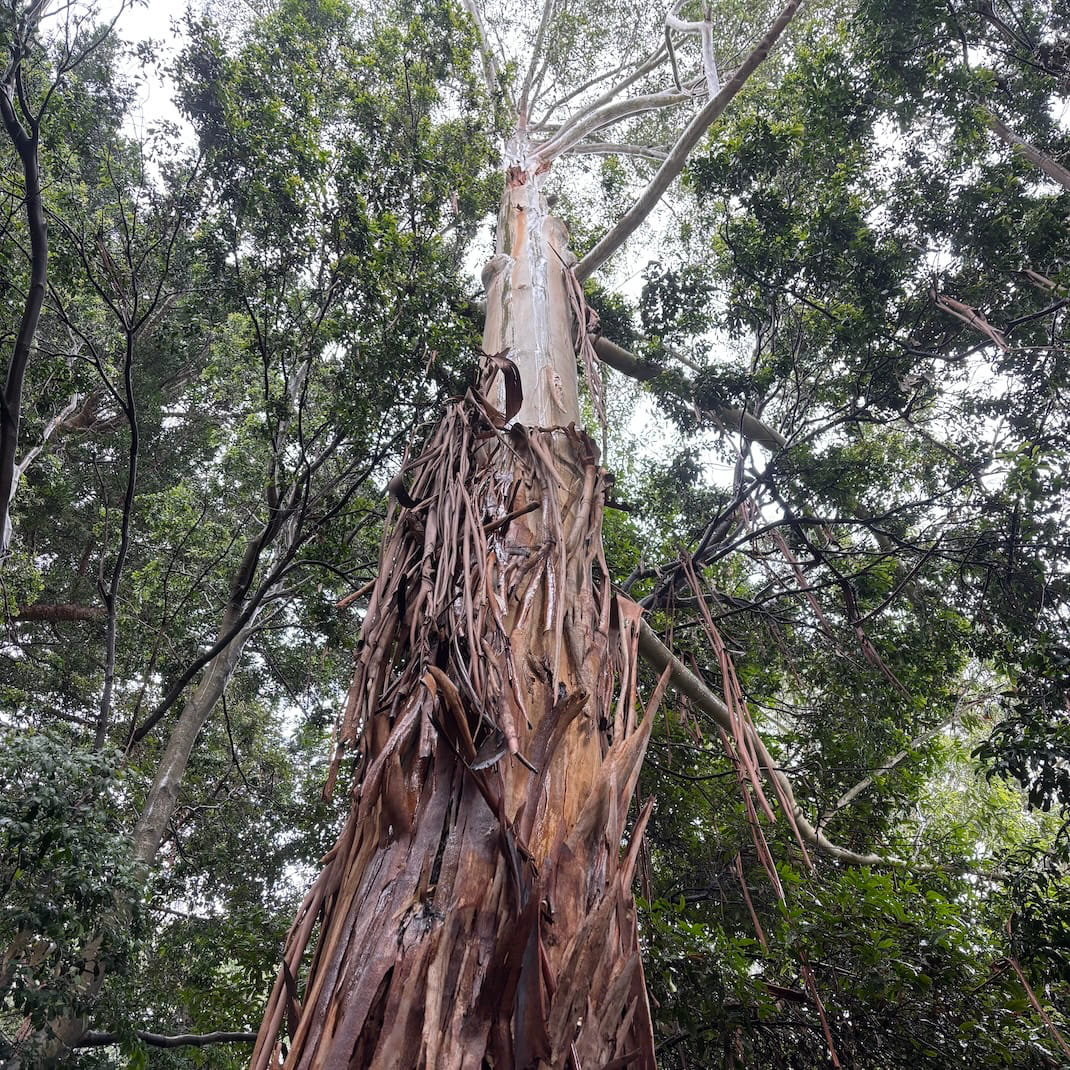
We see them mostly under 100ft. high in the Mt. Lofty Ranges, around Mt. Lofty, Horsnells Gully, Cleland, Basket Range, Deep Creek vicinity and Bridgewater, Aldgate southwards, to name a few of the better sites, but also on Kangaroo Island and in the lower S. East. This is a very attractive tree, usually off-white, smooth-barked over most of its tall, straight trunk, and branches with a stocking of rough bark at its base and often with ribbons of dead bark hanging from the branch forks. It is also found, sometimes, with rough bark extending over much of its trunk.
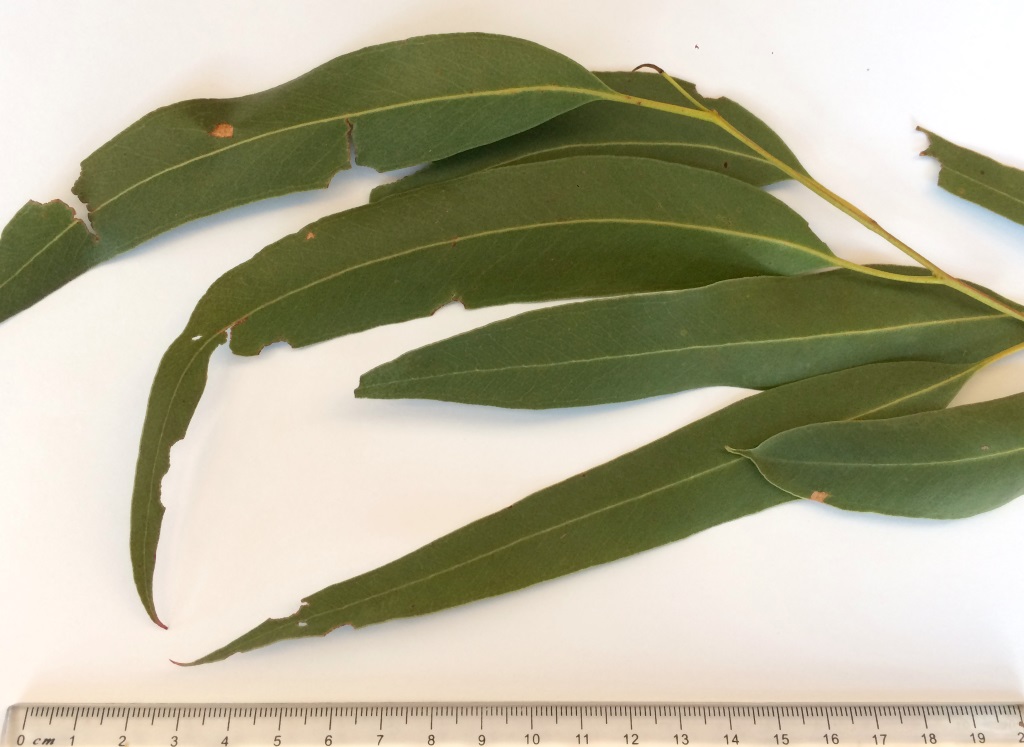

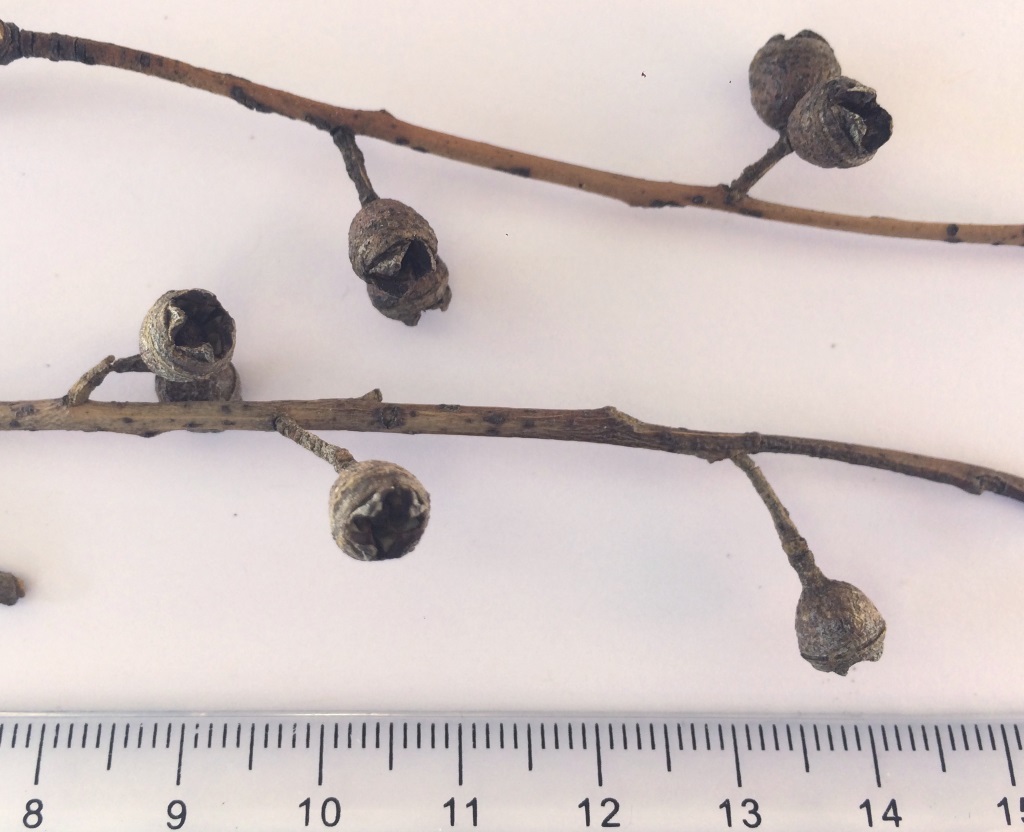
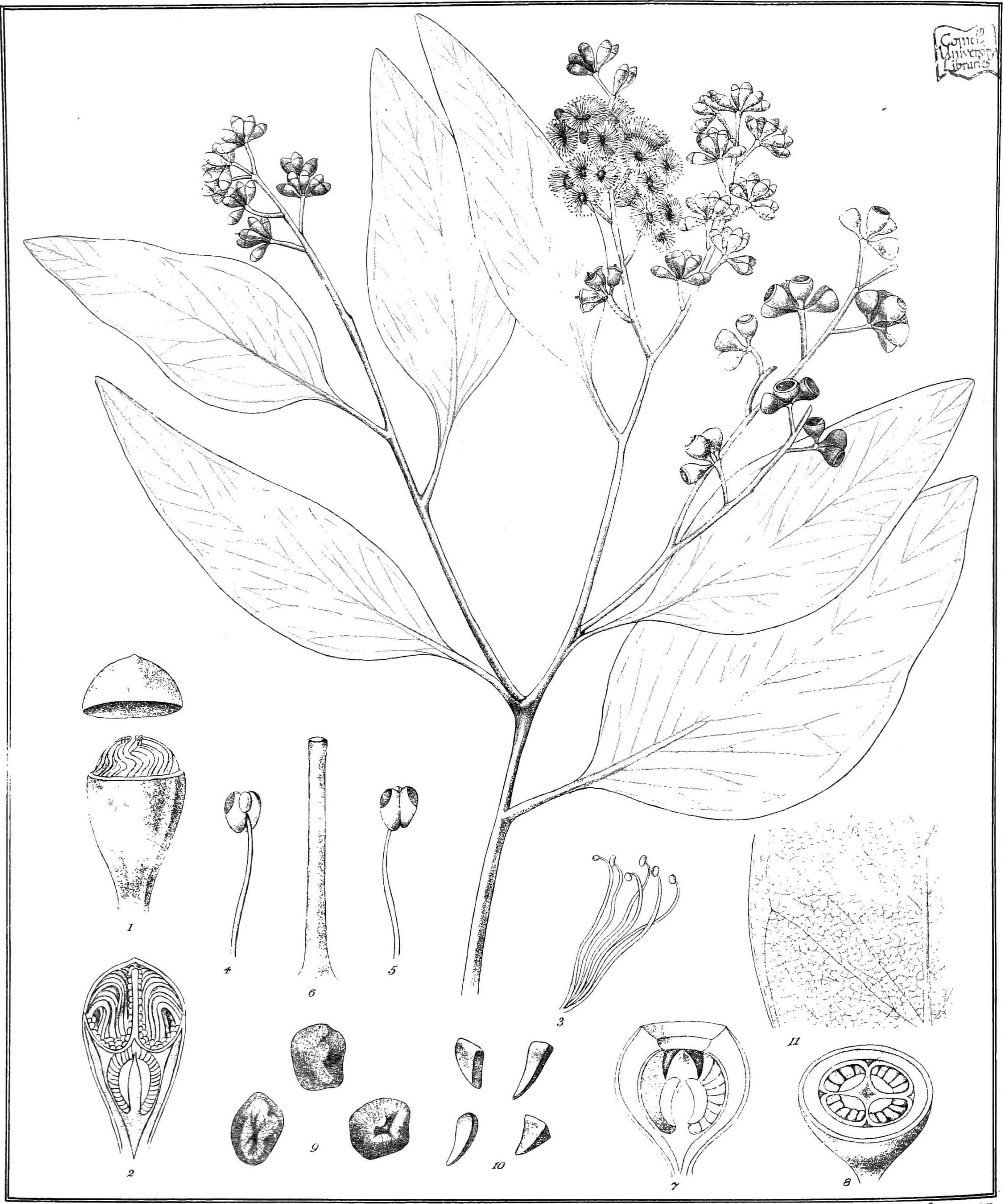
Flowers occur over much of the year. The buds occur in leafy clusters of 3 per cluster on almost no pedicel (flower stalk) and 1cm. peduncle (common stalk – see diagram at start).
The fruit is also short stalked, in 3’s round to a broad rim above which triangular valves protrude markedly. The leaves are long thin and pendulous.

Manna gum is one of the most cold-hardy species, and combined with its rapid growth and attractive form, makes it a popular tree for ornamental planting.
Eucalyptus viminalis subsp. cygnetensis Rough-barked Manna Gum
Rough-barked Manna gum is closely related to the Manna gum but has rough, grey or more or less fibrous bark on the trunk and up to varying heights on the branches.
It is usually from about 20 to 60ft in height, with a much-branched, dense, spreading shady crown. The trunk is often forked in smaller-sized trees but tall and straight in medium sized trees. Some good pictures can be found here.
Rough-barked Manna gum belongs to the smooth-barked gums but it is thought that the origin of the persistent rough bark lies in past hybridising of a smooth-barked species with a rough barked species.
This tree is widely distributed but patchy throughout the Mt. Lofty Ranges and Kangaroo Island, and a small area of southern Eyre Peninsula and the Lower S. East.
It is sub-coastal, prefers cooler districts with a rain of about 25 inches [600mm] and fertile well-drained soils. The fruit is cylindrical to half round on a short stalk, with broad triangular valves protruding obviously from the broad rim. You will see Eucalyptus viminalis subsp. cygnetensis in the north Mt. Loftys, east of Mt. Kitchener in that new conservation park, a small patch south of Pimpala road on the south of Sandy Creek. As far as I know there is a gap in the central hills, but you will find some near Myponga; there are a lot around Millicent and Keith.
Eucalyptus rubida The Candle Bark
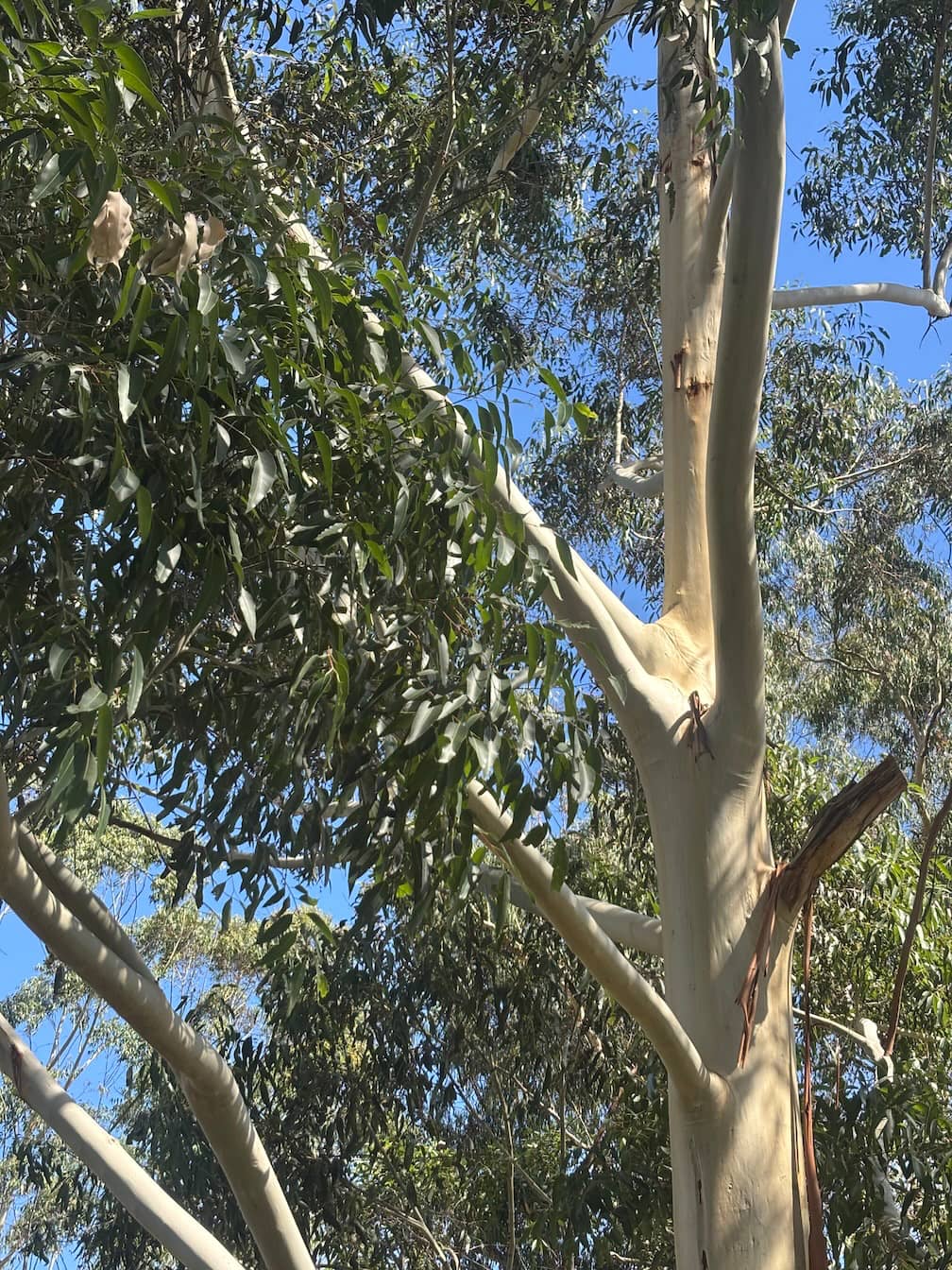
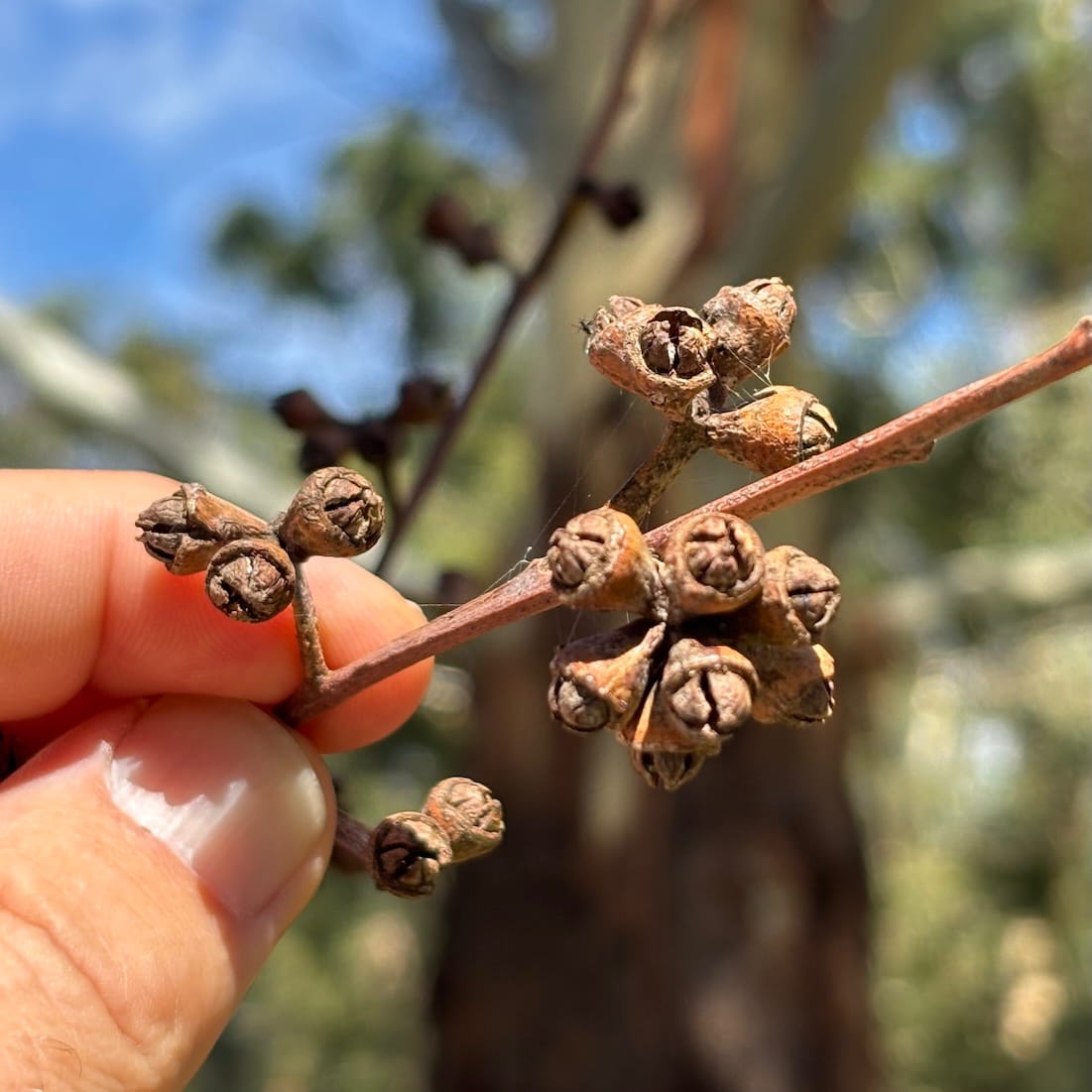
E. rubida the Candle Bark Is in my mind, one of the most beautiful gum trees in the Adelaide Hills. The only trees are in the higher rainfall areas of the hills where the soil is deep, Unfortunately these places were favoured for market gardening etc, so you can guess what happened to them. If you are driving along the freeway between Crafers and Stirling you will see a few; also there is a fine stand near the Onkaparinga between Hahndorf and Mylor, and scattered around Woodside, Lenswood, Lobethal, Ashton area.
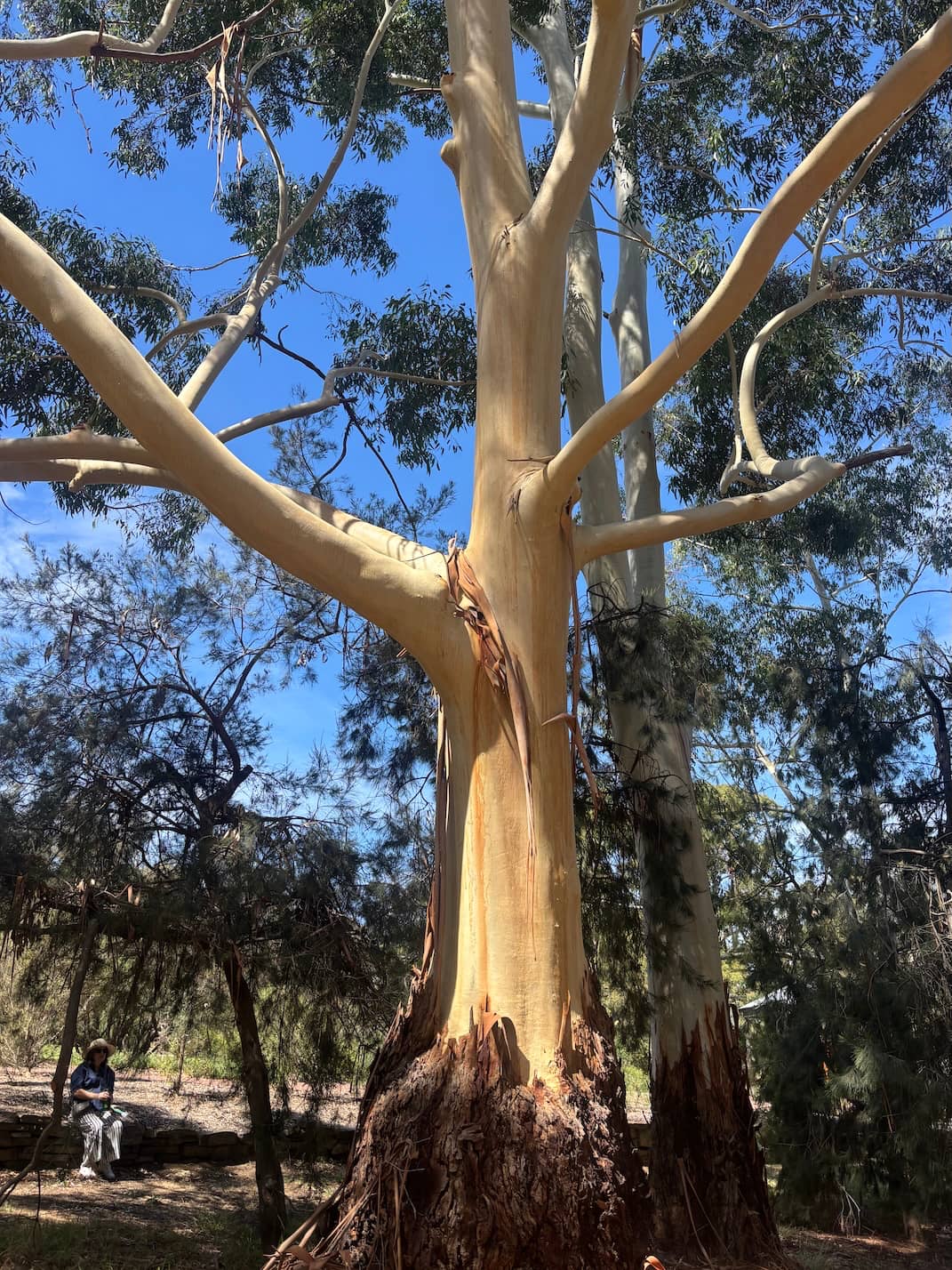
The trunk is smooth, almost dazzlingly white, and straight and the first branches are many feet from the ground. E. rubida is named for the red colour which develops in the bark. It is frost hardy but not drought resistant and is related to the mountain gum of Northern N.S.W. and S. E. Tasmania where it is also found.
Eucalyptus cosmophylla Cup Gum
E. cosmophylla Cup Gum is a South Australian gum tree mostly seen in mallee form from 8-15ft., a straggling, sprawling tree which grows on acid, deeply-leached infertile soils which tend to be waterlogged, for much of the year. You find them mostly in the Lower Adelaide Hills, especially at Myponga, the sands of Cox Scrub and Scott Conservation Park, Mt. Compass and Deep Creek etc. and Kangaroo Island.
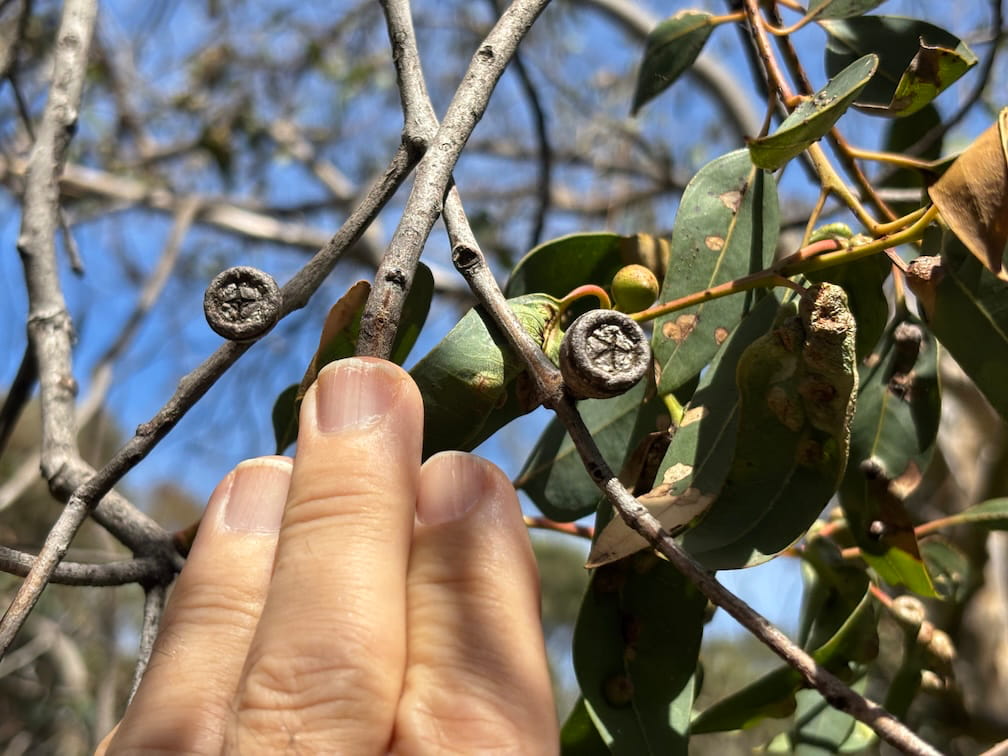
The leaves are very thick, broad ovate to lance-shaped and carved. This is the tree that you will often see illustrated on the front covers of S.A. Eucalypt books for it has about the largest flower (white to pink) set on groups of 3 ‘cup-shaped’ toruses. The broad, thick round fruits can be noticed from a distance.
“Cosmophylla’ means ornamental leaves but they are not the most attractive feature. Apart from the flowers the smooth, pale grey-buff bark is quite attractive. Patches of rough bark may persist throughout the trunk. It is a very good tree for honey.
THE STRINGY BARKS
There are three stringy bark eucalyptus, one of which, E macrorhynca or Red Stringy Bark is found only in one area near Clare and is set aside for its preservation.
Eucalyptus obliqua Messmate Stringy Bark
E. obliqua or Messmate Stringy Bark is the tree which is used so much in the eastern states and Tasmania for the pulpwood industry and for timber for furniture, buildings and construction.
At its best in S.A. it might reach one hundred feet, (often a lot shorter) but reaches 200 feet in Eastern Australia with a straight shaft-like trunk of impressive diameter. Its best growth in S.A. occurs in the wetter district of the Mt. Lofty Ranges (south of the River Torrens) the lower S. East on fertile, well drained soils.
You will see forests of them still around Cleland – Mt. Lofty – Stirling, Bridgewater, Belair etc. but on all the deeper soils of the hills down to Deep Creek[9].
‘Obliqua’ refers to the prominent oblique or lop-sided nature of the leaves which is more prominent than many other eucalypts. This tree is closely related to E. baxteri which often supercedes it on the less fertile soils. The leaves of E. obliqua are long, dark glossy, lanceolate and often thinner and more tapered on the leaf tip than E. baxteri.
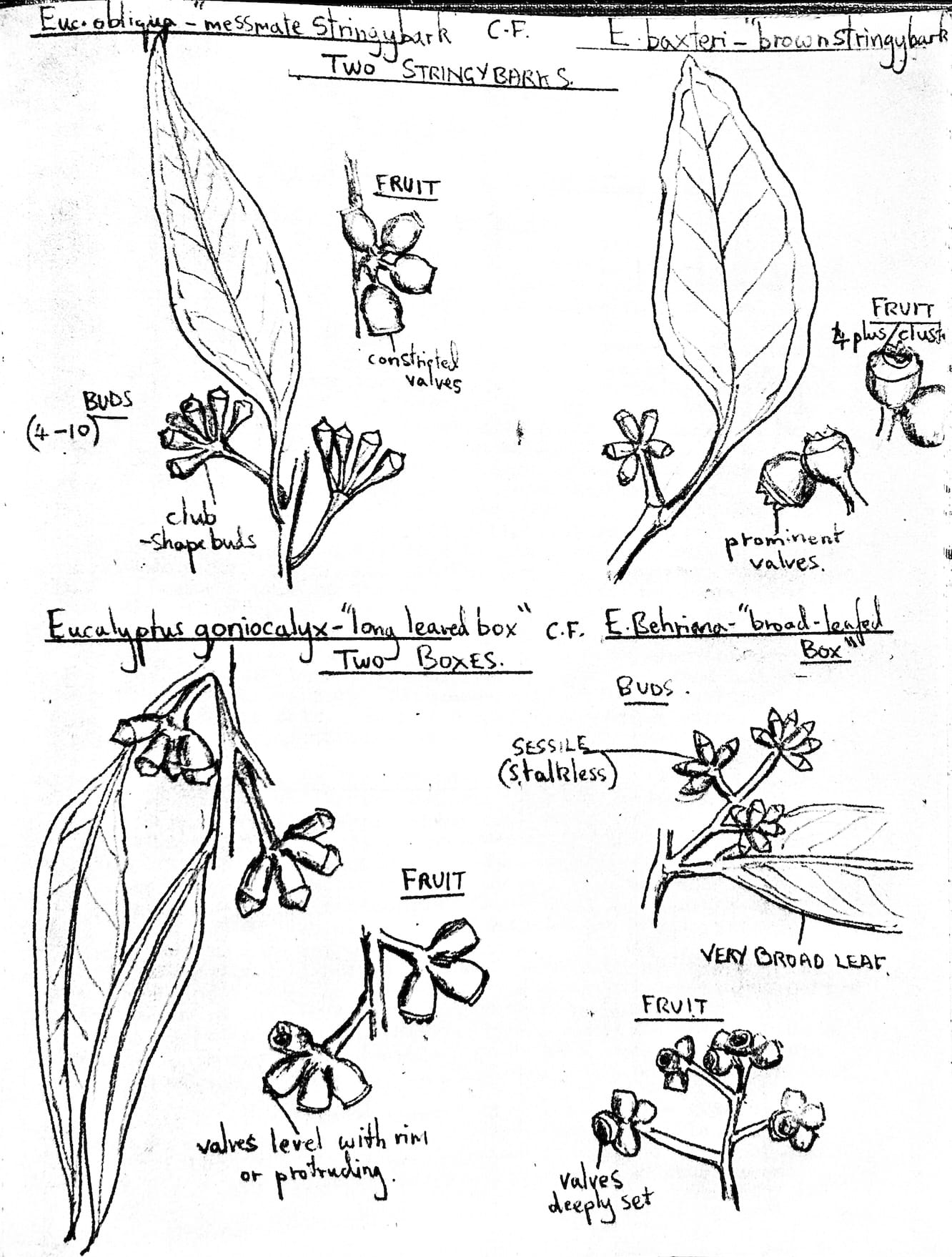
The club-shaped buds of 4-14 are set on a long flower stalk, while the stump buds of E. baxteri occur in clusters of 4-10 on a short thick cluster stalk.
The fruits are the best way to tell the two related species apart. Those of E. obliqua are ovoid to pear-shaped and thinner-rimmed with narrower torus than E. baxteri and with the small valves set well below the constricted rim compared to baxteri’s prominent raised valves.
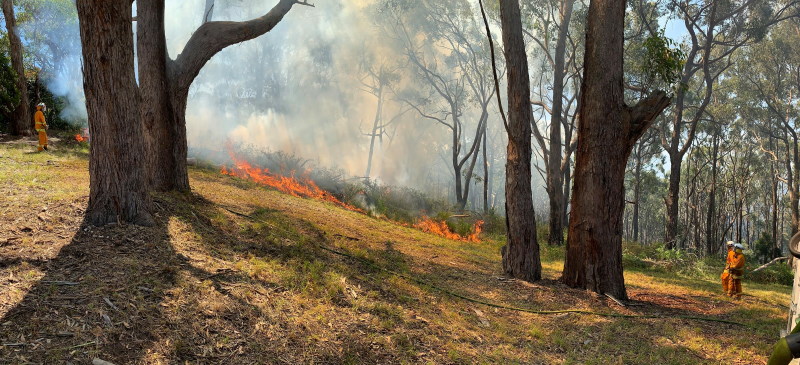
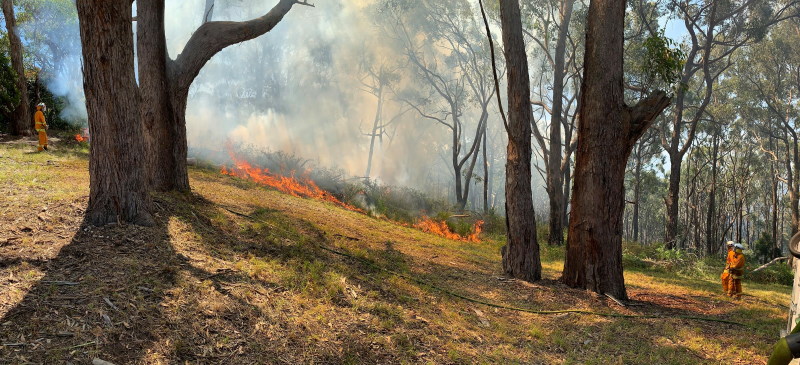
Bushfires often ravish stringy bark, and the bark stays on black for years.
This stringy bark has long interlacing strands of dark fibrous bark persisting upwards on the trunk to the major branches.
Eucalyptus baxteri Brown Stringy Bark
E. baxteri or Brown Stringy Bark can also be as tall as Messmate, but is generally found on poorer ground and rarely exceeds 20m in height. Therefore, a tall, straight stringybark is likely to be E. obliqua.
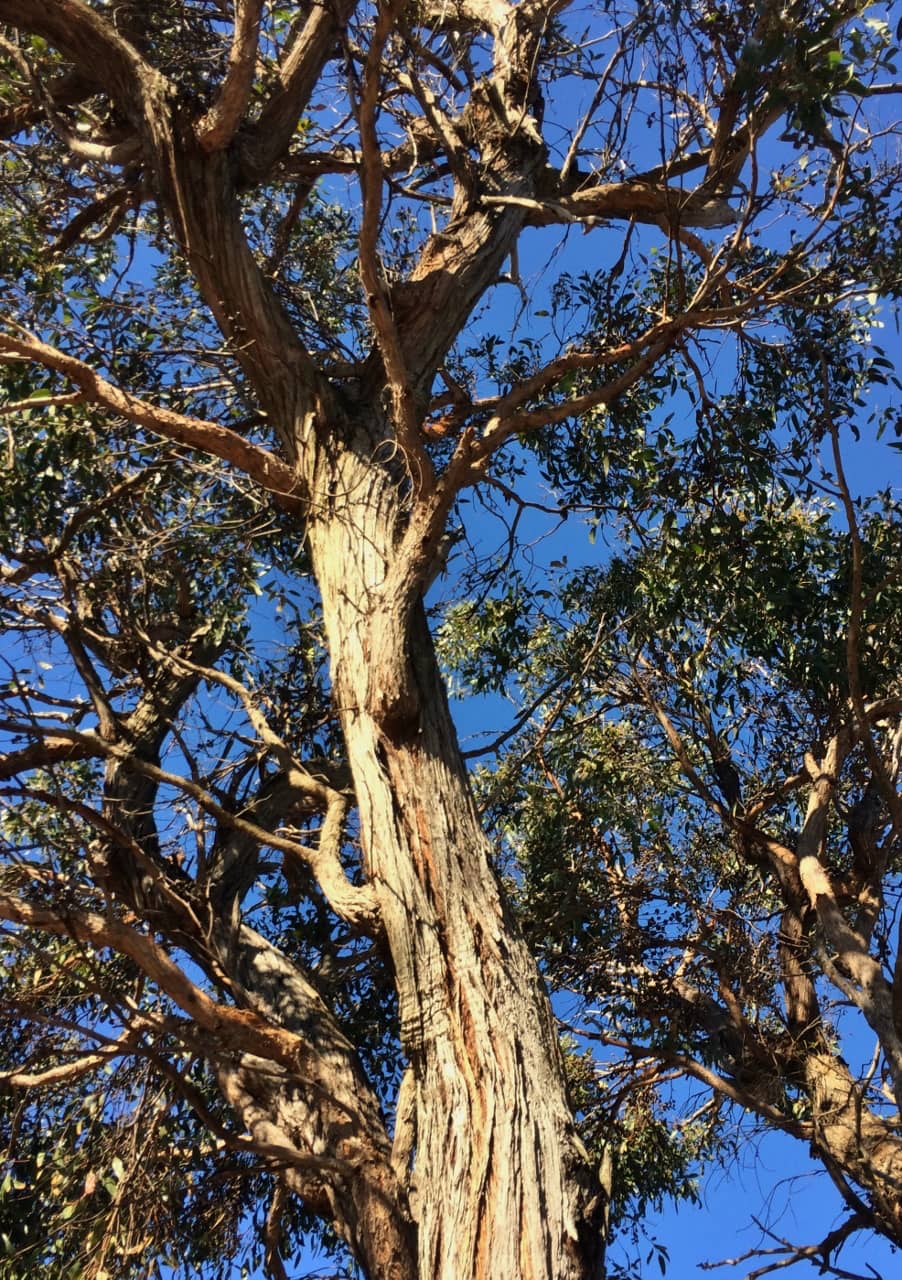

E. obliqua is common in Cleland National Park and E. baxteri can be seen in Black Hill Conservation Park and in good stands, southeast of Adelaide and in Scotts Conservation Park. E. baxteri, though in general terms strongly resembling E. obliqua is more tenacious and will survive under harsher conditions, sometimes even mallee-like.
The fruits occur in tight stalkless clusters with a spherical to hemispherical shape, with a wide and raised rim and with the broad triangular valves usually protruding above or level with the top of the rim.
THE BOXES
Some of the boxes were among our most common trees[10]. However, since European settlement, most of the Grey and Peppermint Box Grassy Woodland of South Australia has been cleared or degraded to the extent that these ecological communities are now listed as Endangered and Critically Endangered respectively.
Eucalyptus microcarpa The Grey Box
Grey box woodland feels like it was once the dominant vegetation type on the western slopes of the Adelaide Hills. Lovely remnants remain in Waite Conservation Reserve and scattered among the hills reserves and suburbs.
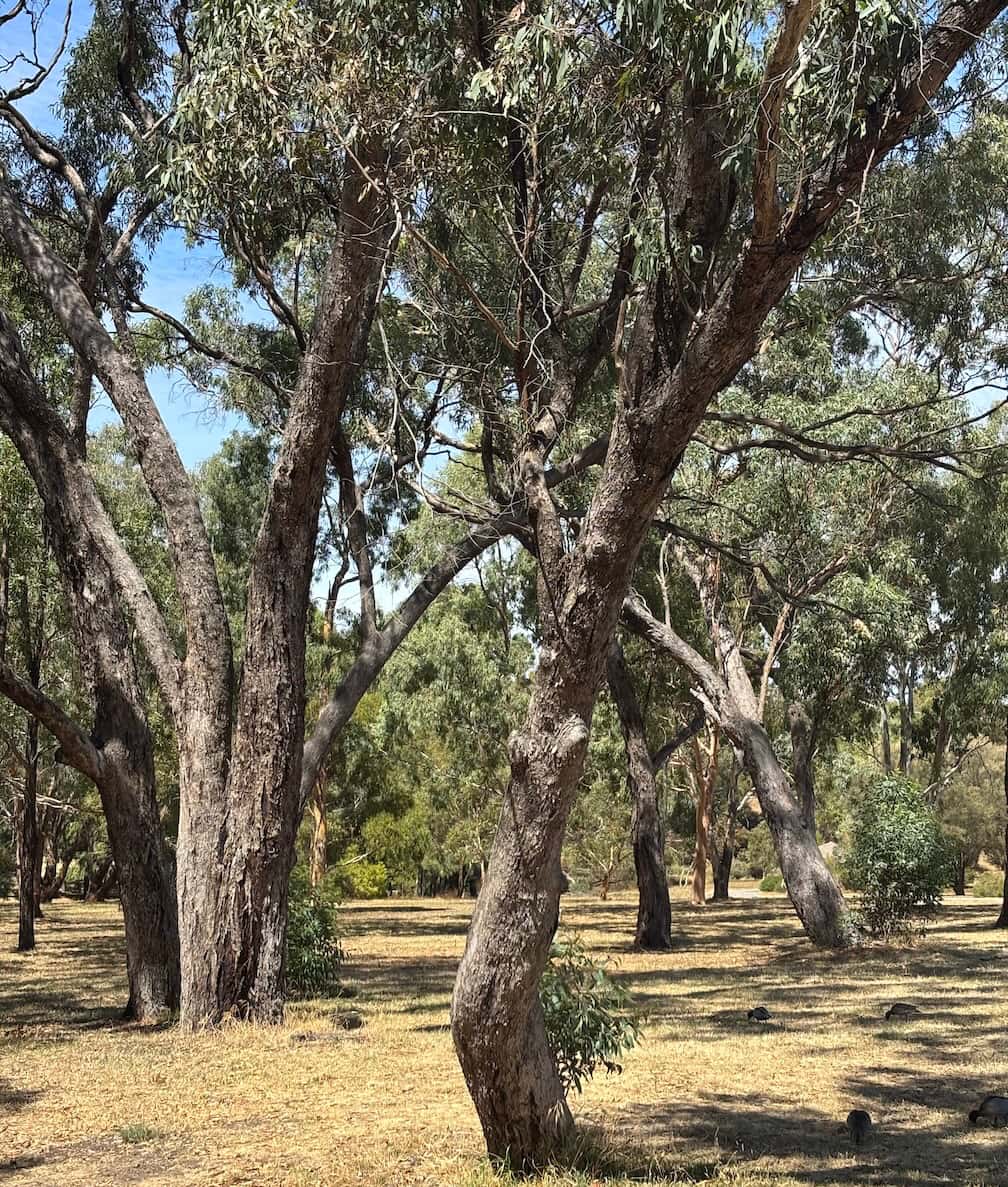
Grey box vary greatly in size from 8–25 m, with typical tightly held, grey, finely fissured box-type bark right up to the small branches. The leaves measure 65–150 × 12–25 mm.
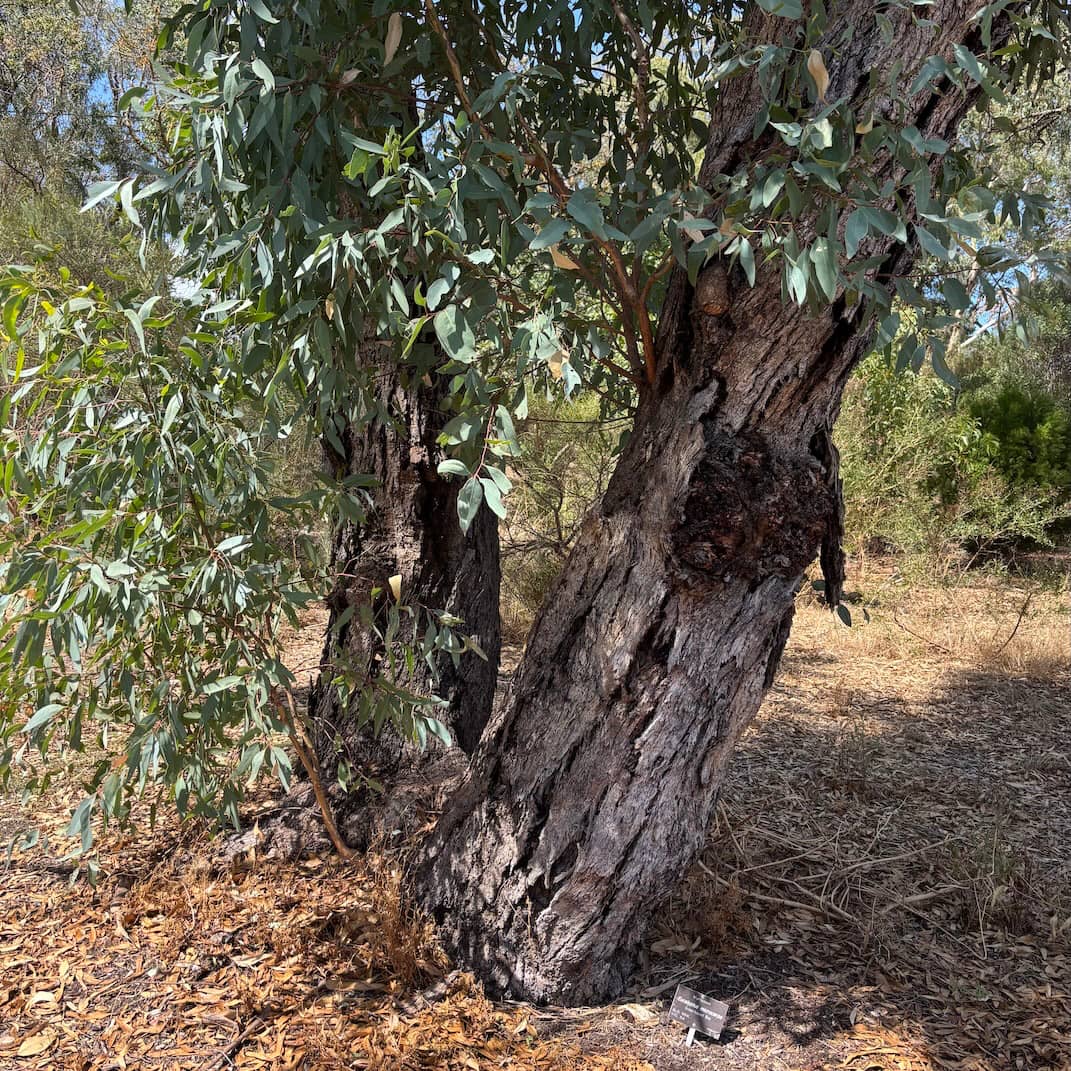
Eucalyptus odorata The Peppermint Box
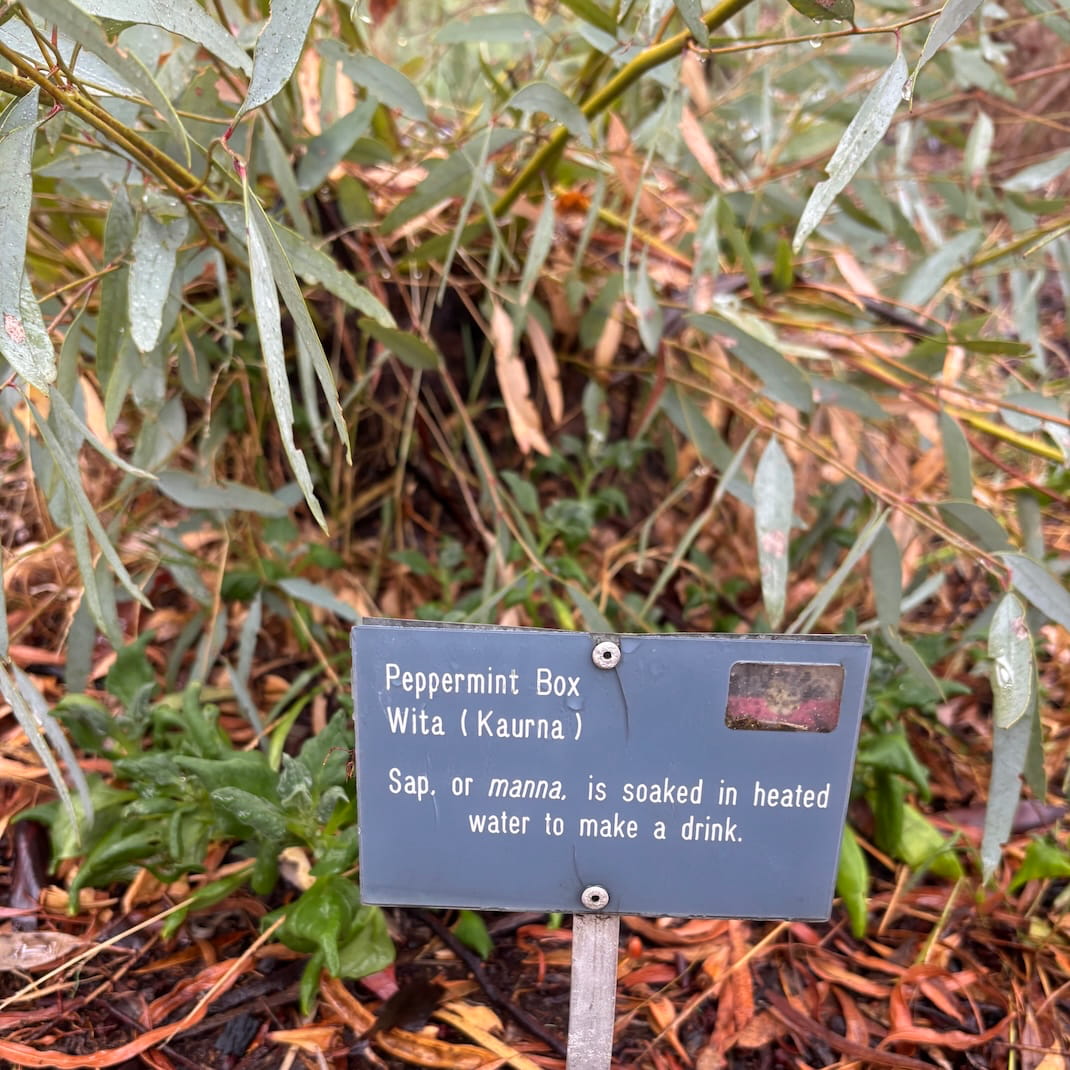
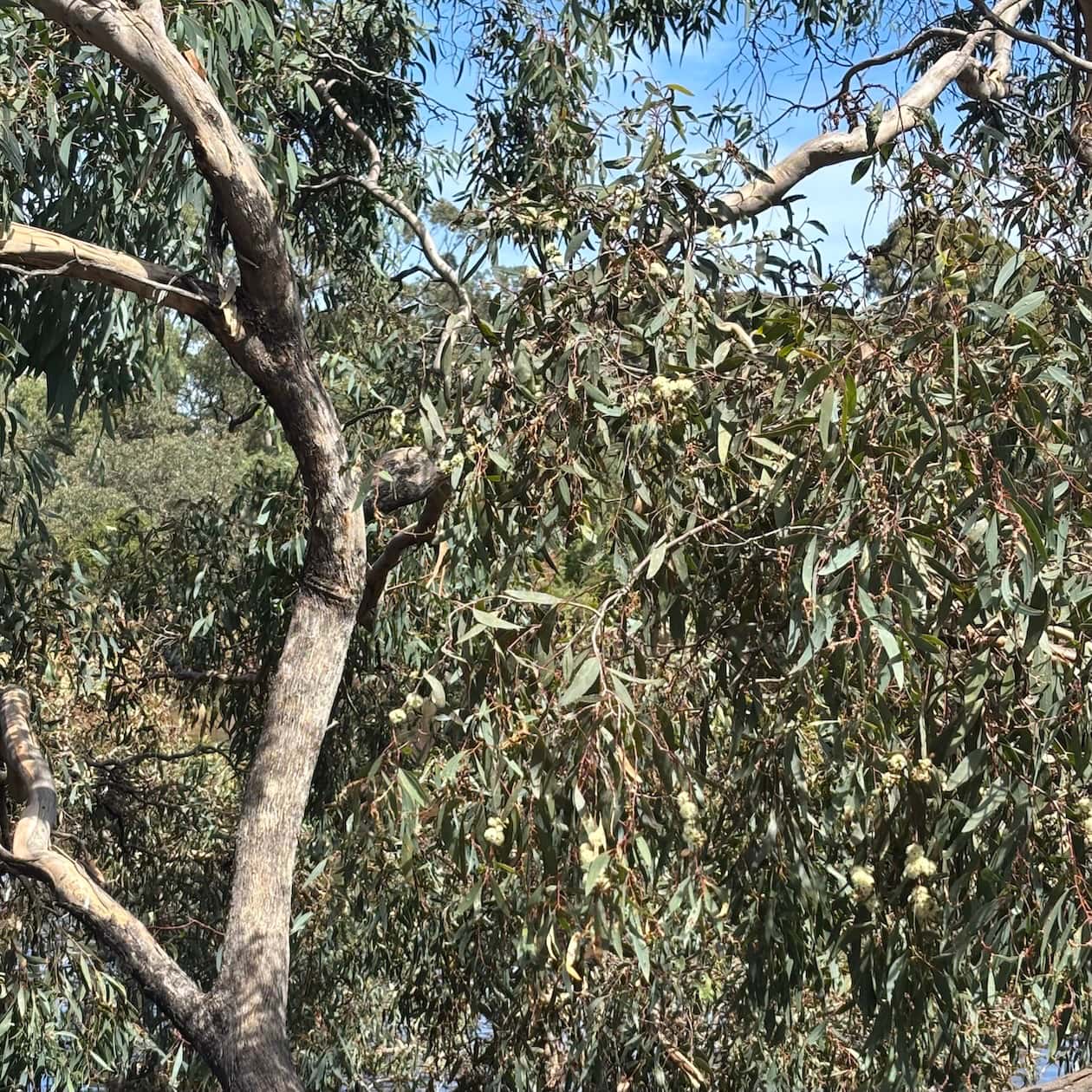
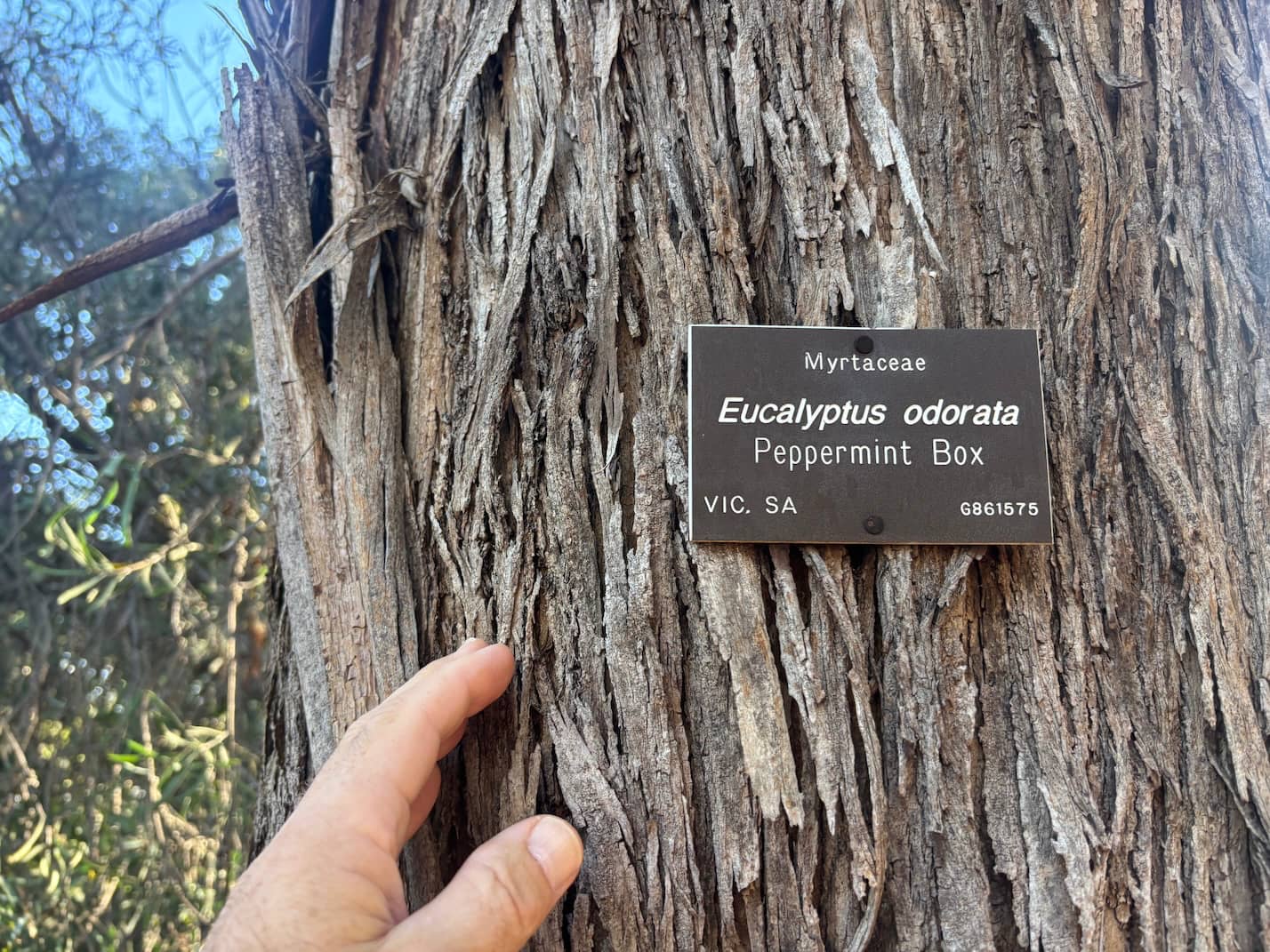
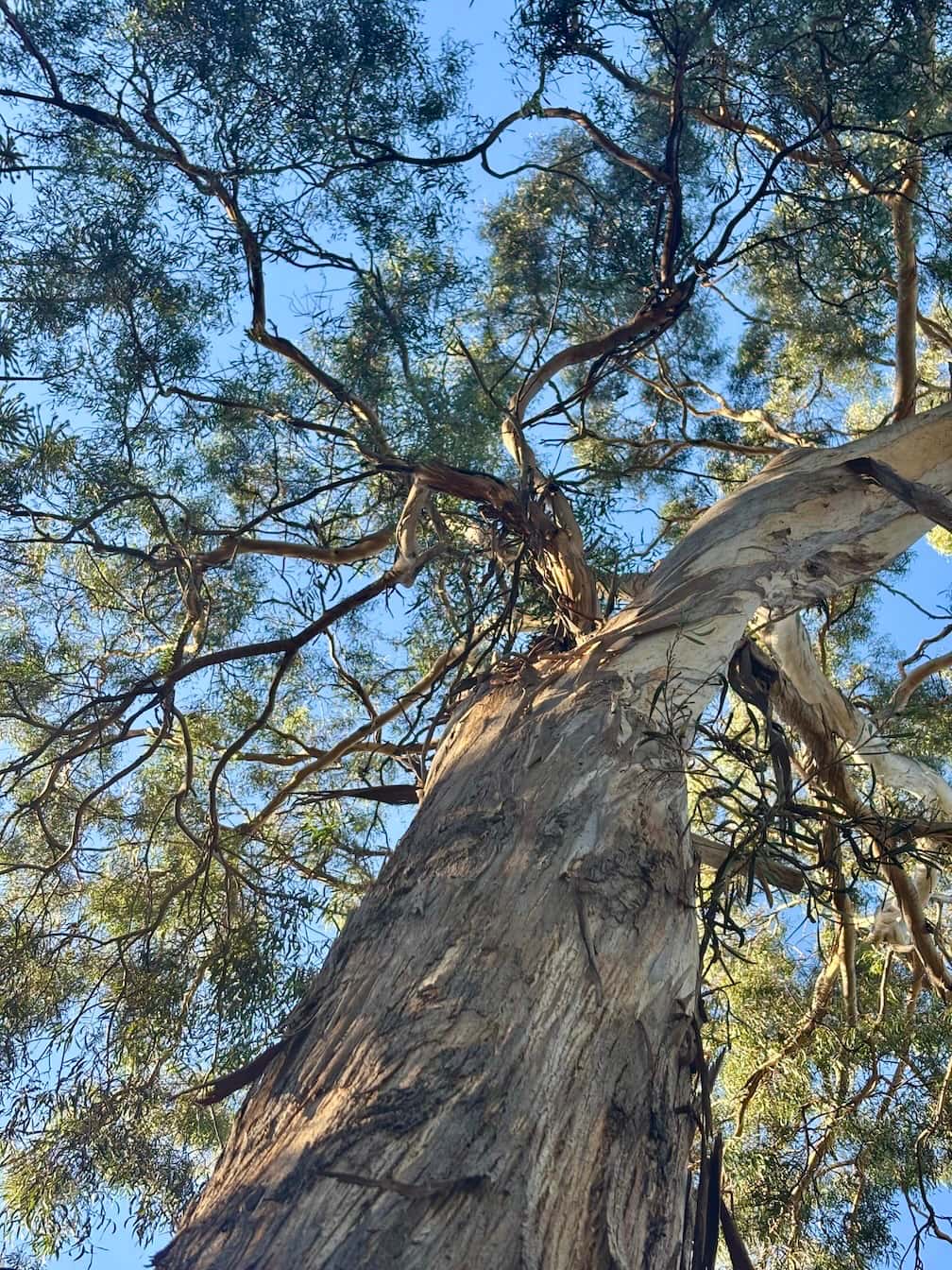
Peppermint box are closely related to Grey box, but have some key differences. They are smaller and often multi-stemmed, growing 2–12 m high. The bark is more variable, usually grey-brown and rough up to medium branches, hard to somewhat flaky, smooth above or sometimes smooth throughout in smaller plants. Leaves are noticeably narrower and somewhat shorter.
The biggest difference between the two boxes is where they are found. If you are on the western slopes facing the Adelaide plain, you are almost certainly looking at a Grey box. If you are on the Fleurieu or Kangaroo Island, it’s almost certainly a Peppermint box. Through the lower Flinders both can be found, but the Peppermint box is more widespread.
Eucalyptus goniocalyx Long-Leaved Box
E. goniocalyx or ‘Long-Leaved Box’ is quite an attractive tree found north of the river Torrens, restricted mainly to poor sandy or rocky areas over 1000ft. in the Adelaide Hills with outlying patches of it over 3000ft. in mallee form in the Flinders Ranges near Wilpena; also found in the Southern Flinders on the Clare Ranges and Mambray Creek. The common name refers to the unusually long foliage of this box compared with the shorter foliage of other southern boxes, while the botanical name refers to the presence of ridges on the buds. You will see it in Humbug Scrub, Warren and Hale Conservation Parks, Anstey’s Scrub and Mt. Kitchener as a medium tree up to 40 ft. high. It has a yellowish-grey box bark, which is rough, sub-fibrous (flakes off in pieces) and is persistent to the secondary branches.
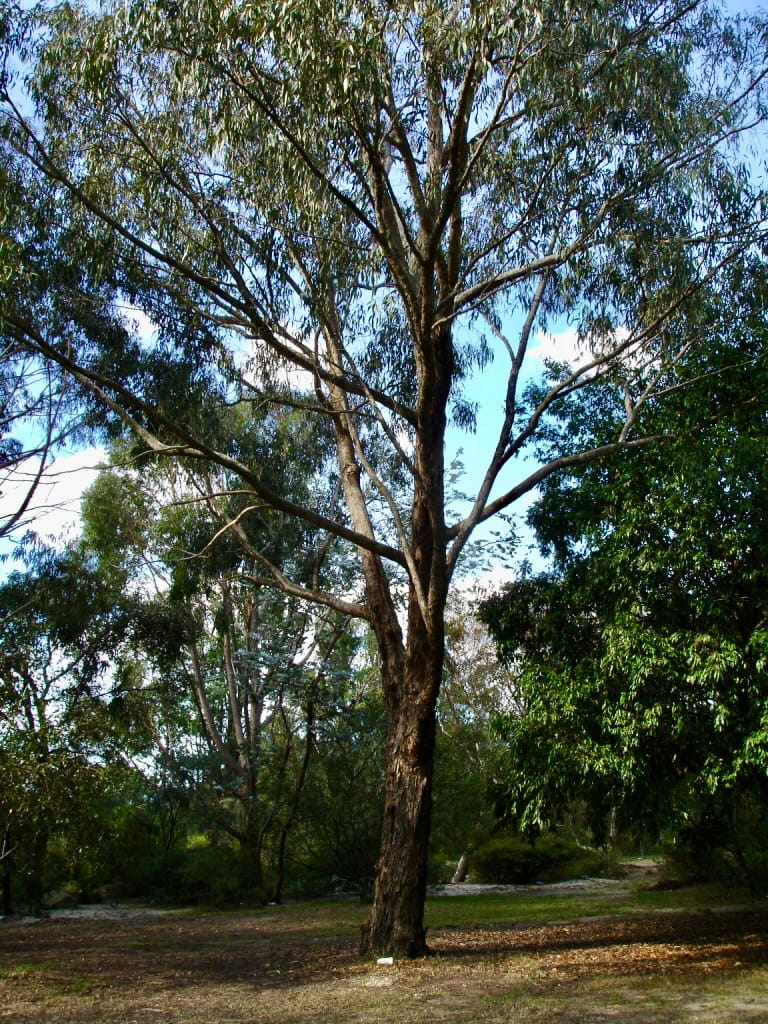

The seedling leaves are a handy guide to identification. They are opposite, stalkless and elliptical for about 3 pairs then the next pairs are circular to heart-shaped, waxy to bluish-pale green.
The blue, large leaves contrast very well (looks like a separate tree at its base). The adult leaves are long, narrowish, shiny green, often hanging in sickle shape formation.
The buds, occur in leafy clusters and the individual buds have a cylindrical torus which is angular and longer than the conical cap. The cluster stalk is usually stiff and flattened and white flowers appear in winter.
The smooth cylindrical fruit has 2-3 ridges at the base. It has a narrow rim, with valves level with, or slightly protruding above the slightly contracted orifice.
Eucalyptus behriana The Broad-Leafed Box
E. behriana or The Broad-Leafed Box is a medium sized mallee or more often a small shady tree to 30 ft. high with a short trunk which supports an open crown of spaced thick wide foliage. The bark is dark grey, rough, and persists on the trunk, becoming smooth about half way up.
In contrast to the seedling leaves of E. goniocalyx, these seedling leaves are opposite for 3-5 pairs-short-stalked and broad ovate from the 4th to 5th pair.
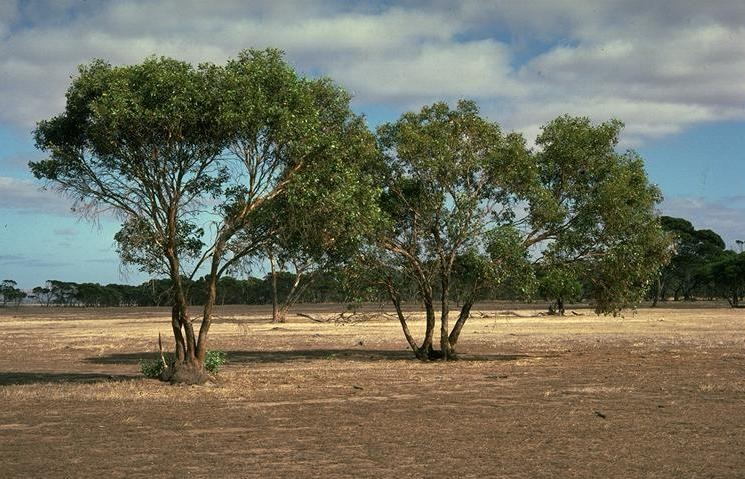

Broad-leafed box occurs in small exclusive patches or mixed with other eucalyptus on lower Eyre Peninsula, central Mt. Loftys to the Southern Flinders and upper S. East to Bordertown.
The fruit is stalkless, cylindrical, short, about as wide as long with a narrow rim and small valves which are far below rim level. averaging up to a cm. in diameter. It makes good firewood.
This is just a brief encounter with some of the gums seen on walks on our own back doorstep – the Adelaide Hills. There are many trees which are real characters in their own natural settings, trees which on recall we can visualise as being part and parcel of that landscape. As much as we try, we cannot quite recreate these scenes in our gardens. Many bushwalkers could not, on visualising the red gorges of Alligator Gorge Conservation Park, not also see those beautiful river red gums with their white trunks and huge twisting limbs reaching up for the light.
I hope I have given you a taste of the interest to be found around us in knowing our gums a little clearer, whether we see them in the cities country roads or bushwalking – they are our heritage.
Tony Mardel, Spring 1979
Editor’s Footnotes
- There are now over 700 recognised species. Planting of non-endemic species has only escalated and made the job of identifying the locals even harder.
- Though widely called Latin names, they are just as likely to be taken from Ancient Greek.
- It is curious that in each of these three bark groups, there is a pair of trees which are a diagnostic challenge in SA: red gum vs blue gum, messmate vs brown stringybark and grey vs peppermint box.
- I have heard that the grounds where it was cultivated and first described was a former monastery in Naples.
- Also, blue gum leaves are larger, the trees appear generally more elegant and their bark shows yellow where the older bluish bark peels away.
- I can attest to this. If you want to host the widest variety of native birds in your garden, plant an SA blue gum with some native shrubs underneath!
- Another way to identify pink gums from a distance is that they are often heavily infested with lerp scale on their leaves. This gives them a rather sickly look.
- Now a part of Mount Remarkable National Park. There are many beautiful avenues of sugar gums throughout the parklands and in Belair National Park.
- In the Adelaide Hills, stringybarks tend to dominate the higher and wetter elevations, so a typical hill climb will pass through a transition from E. leucoxylon and E. fasciculosa to E. baxteri or E. obliqua. These latter are the dominant species around Mount Lofty. Further south, it is a safe bet that they are the majestic trees around the Stringybark campground in Deep Creek.
- There was to be a second article which would have included two further significant boxes Eucalyptus microcarpa The Grey Box and Eucalyptus odorata The Peppermint Box. I have added these to the text above for completeness.
Gave up trying to identify eucalyptus decades ago. Decided my memory wasn’t good enough to differentiate over 700 species.
Would be a different story if they are edible.! Although some of their parasites are edible. But a bit bland.
Will donate my Kelly’s Eucalypts volume 2. To the club
Peter M
Yes – those of us who aren’t botanists can only hope to be right a percent of the time, but it’s not too bad if you stick to natural vegetation. In each area there are only a handful of common trees. It gets close to impossible when people start planting ornamentals and non-endemics.