
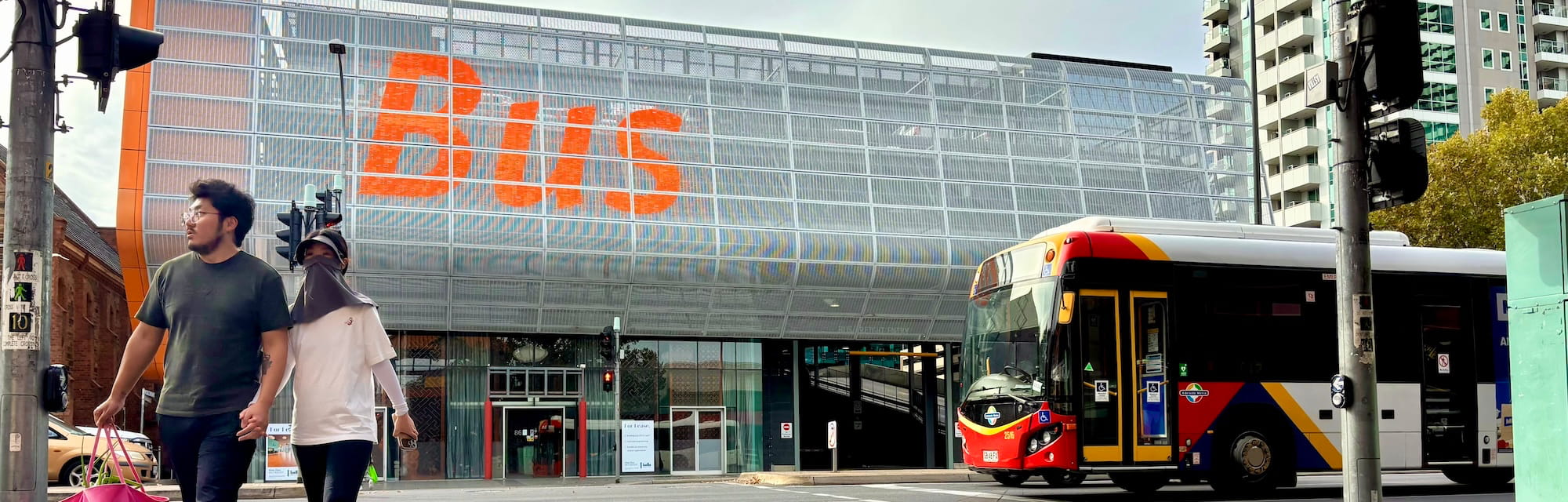
In part two of our series on walking South Australia by public transport, life member Mike gives some additional detail on bussing to bushwalks, along with few travel-related tales.
I love it when you can set off and complete linear walks by simply catching a bus or train at either end. You can often do so for interstate walks, most recently for me, Victoria’s Great Dividing Trail (and now with free transport!) and coast-to-coasting Tasmania. Walkers of WA’s two most popular long walks (Bibbulmun and Coast to Coast) are spoilt with travel options, with buses to all towns linked to Perth directly or via the Bunbury train service. But it’s a bit different here and this is largely due to our small rural populations.
With the single exception of the vastly expanded bus services to God’s great waiting rooms of Goolwa and Victor Harbour, bus services to most of the more distant regional areas have declined in recent decades, and this due to both the serious decline of many rural populations and our strong preference to travel by car. (Minnipa and Peterborough are towns that I know well which now have far smaller populations than formerly while Leigh Creek’s population has fallen from 2,500 to less than a hundred.)
Stark evidence of the decline in services (and the need for bus companies to reduce costs) is the current once-a-week only bus to the west coast (Kimba-Ceduna) and the move of the Port Augusta bus stop from a centrally located bus terminal/café of a decade or so ago to the front of a very un-central service station. Despite all this, there are still opportunities to take the bus option for a good number of day, weekend and more extended walks.
Public Transport Options for Bushwalkers
So, just what are the public transport options for getting to and from good places for walking? The following list is an attempt to provide some answers to that question. All the bus services mentioned start at the Adelaide Central Bus Station in Franklin Street. Some bus trips to the southern Fleurieu Peninsula may commence at one or other of the southern train/bus interchanges. This likely also applies to the Gawler train for walks (or perhaps more especially for bike rides), in the Barossa.
Adelaide Hills or Mount Lofty Ranges
There are too many options and too much complexity to deal with here. Peter Muller has recently written an excellent article on Heysen Trail connections that you can find here.
Great South Coast Way (74 km).
Peter has also covered this well, and here is more food for thought…
The daily bus services to both ends of the Way makes this walk very accessible. An advantage of starting at the Cape end is because the more frequent services at Victor Harbor gives you more travel options should you finish the walk later than expected.
Bus travel only fits in with doing the whole trail of course, or an out-and back or loop walk from either end.
Should you have such an ambition, I know from experience that a fit party travelling light and willing to put in two seriously (deliriously?) long days, can do the walk in a weekend. Take the 5.30pm bus to Cape Jervis and Monday’s 6.43am Victor Harbor bus/train trip and you’ll be at North Terrace at 8.17am. I can find no posted times, but I suspect that runners would do the trip in 7-8 hours. The WSCW truly deserves to become one of Australia’s great classic run events. You’ll find all the bus/train details here.
Onkaparinga River: Clarendon to the Sea.
A must-do walk! It’s not far to drive to the start (thinking of fuel costs here) except that it is likely to require car shuffles but why do that when bus and train travel serves the walk pretty well? It’s a train home from Port Noarlunga but getting to Clarendon may not suit everyone. The only option is the 3.40pm 1257 Urrbrae HS bus which will get you to Clarendon within the hour. Catch a 632 or 170/172 bus from the city to the School bus stop on Cross Road. This bus only runs during school terms!
(When the club did this walk over a decade ago, we went on the now extinct ‘Clarendon’ bus which started at the Aberfoyle Park bus interchange around 6.30pm and with that later start probably suiting more people. Curiously enough, it dropped us off amidst paddocks on top of Chandlers Hill where it turned around. As a prospective leader, and with my leadership abilities on trial, I did feel a bit silly as I had told everyone that we would be dropped off in the town. But no sweat, it was all downhill and we were still in time to enjoy a pub meal.
Clarendon has a free designated grassy camping area next to the bowls club. Next morning, you take the shortest route across a paddock to the creek. The national park starts at the messy scrubby stuff beyond the fence. It’s nice to follow the creek to on the beach but that option might lose some of its appeal if you’re feeling a bit weary. Half an hour earlier than that, you walk close by the railway station, so piking is always an option.
South-East Coastal Walks.
The Stateliner bus to Mount Gambier provides 5 inland and 3 coastal services a week.
Robe to Beachport (58 km) This is probably the most obvious and feasible walk along the SE coastline but you may be sharing the beach with 4WDs for much of the way, unless high diesel prices put a dampener on it. The same bus service of course applies for walks along the Coorong.
Buses: ADL-Beachport Thu. 12.1 – 5.13 pm bus and Robe-ADL Mon. 10.00 – 2.55 pm.
Walk the Yorke (490 km).
Yorke Peninsula Passenger Service (peninsula coaches.com.au) gives you the option of doing the 490 km walk in three stages while the east coast section can be broken into 2 or 3 smaller stages because of the many coastal towns along most of the way. The trail always seems to have a dedicated water tank just when you need it.
Edithburgh to Port Wakefield (154 km): Doing the east coastline in this direction lets you take however many days you like for the walk within the only constraint being the twice-weekly bus to Edithburgh.
Buses: ADL to Edithburgh: Mon. and Fri. 4.00 – 7.50 pm. (or Edithburgh to ADL: Mon. and Fri. 0700 -11.10am). Port Wakefield – ADL: Several buses each day.
Hardwicke Bay to Edithburgh (224 km, 6 or up to 11 days): Decision time! Weekly and twice weekly bus services to those two settlements respectively, means that you need to complete the walk in either 6 days (a big call) or 11 days. I am still to walk this section and my preference is to go anticlockwise as this leaves you (including those who fail the 6-day challenge) with the benefit of taking your time and having the opportunity of continuing on north from Edithburgh and catching the bus somewhere further along the coast. Maybe the coastline can sometimes seem a bit monotonous, but I think that arriving at little towns along the way (pie, pastry, coffee, pub maybe!) will always be bright spots along the way. Only the east coast leg is really blessed with them.
Buses: ADL to Hardwicke Bay: Wed. 4.00 – 7.35 pm.(Hardwicke Bay is a diversion and drop-off is by request only), Edithburgh to ADL: Mon. and Fri. 07.00 – 11.10 am.
Hardwicke Bay to Moonta Bay (112 km): With just the weekly service to Hardwicke Bay and almost a daily service to Moonta Bay (every day of the year except Saturday and the Sunday of a public holiday Monday), it seems prudent to head north in case of any delays.
Buses: (Hardwick Bay by request only when booking!): ADL to Hardwicke Bay: Wed. 4.00 – 7.35 pm. Moonta Bay – ADL: Mon.– Sat. 0745 – 10.00 am, 1.15 – 4.15 pm. Sun. 10.45 – 2.00 pm. No Saturday services. (ADL to Moonta Bay: Mon. – Fri. 4.00 – 7.00 pm, Sat. 11.30 – 2.20 pm, Sun. and public holiday Monday (when no Sunday service): 3.00 – 5.55 pm.
The Flinders Ranges by Public Transport
ABW’s first trips to the Finders were possibly all done by train, with parties alighting at different stops to walk into the ranges. Possibly the club’s first trip to the northern Flinders was by the Ghan to Copley and from there, by a pre-arranged drive to Yankaninna (this trip is featured here). A fairly circuitous route took them to Beltana for the trip back home. (And this following an irresistible beer and meal at Beltana Hotel and that worthy premises reopening last year after a seven-decades hiatus. I can hardly wait to go there!). This might explain why my Warraweena hike filled up so quickly! Ed.
My own first-ever bushwalk started on a packed Friday evening train to Wirrabara. It was packed with workers going home for the weekend and I sat next to an ‘elderly’ woman, a headmistress of a private school she told me, who spared no effort in instructing me how to lead a more orderly life and of the many benefits that might well accrue from it.
I suppose the fact that I had no ticket may have given her the impression that general disorderliness ruled my life. The leader had it but he, along with the rest of the Flinders Uni group, were nowhere to be seen. The station kept my rucksack for security while a kind family put me up for the weekend. The group, much to everyone’s relief, turned up on Sunday night.
Southern Flinders Ranges
Over a decade ago, you could go to Mambray Creek for a weekend walk by catching a late Friday afternoon (around 4 pm) Whyalla-bound Stateliner bus to the Mambray Creek turnoff and you needed to indicate this on booking. Catching a late Sunday night bus (around 6.30 pm) got you back to Adelaide.
It was already dark as I waited there and if I didn’t think to wave my torch when I first saw the bus – it was really moving – it would not have stopped. The driver told me that he had completely forgotten all about me.
You can no longer do this as there are no longer any later services on any day of the week. While you can still go by bus, it’s nowhere near as convenient and it rules out any sensible weekend option. If still interested, then check out the Stateliner’s Whyalla, Port Lincoln and Ceduna services online. Unfortunately, with the cessation of the Genesis bus service (see later), there no longer seems to be any straightforward and practical way of going by bus to the east side of the range, e.g. from Melrose or Wilmington.
If you, dear reader know more, please leave a comment below!
Central & Northern Flinders Ranges
The news is terrible! Just terrible and I am in shock! I have just discovered while writing this, that the weekly Genesis bus service to Copley ceased operations in 2024. It started out as a twice-weekly service to Arkaroola, and which later-on halved but was still very useful (I had used it on two occasions to get off at Depot Springs and Angepena and walk to Beltana and Parachilna, and from there, catch the bus back to Adelaide.)
Too soon afterwards, it went no further than Copley, initially with two, and then just the one service each week. Even so, it was still very useful for getting to the Flinders. On one occasion, I used Genesis to get back to Adelaide after leaving my terminally ill car at the rear of the Copley garage. A couple of other trips and then the final one – a regrettably long 4 years ago now – to do two circuit walks from Leigh Creek. (One of 4 days following Windy and Emu Creeks into the eastern hinterlands followed by a 2.5-day loop along the low western range beyond Aroona Dam. Both walks were far more interesting than you might think). A fond memory I have of Genesis is, in Adelaide, giving the driver a six pack and spoon to drop off at Angepena. I’d previously detoured there on a bushwalk to borrow a spoon and the six pack was to acknowledge their kindness and the fact that it took me four months to return it. No packaging required and Genesis asked for no payment.

It’s a great loss and this now only leaves the services offered by Angorichina and Alpana; both can be a godsend but probably not a cheap option for solo walkers. The new normal for buses can’t be leaving Heysen Trail walkers with much to celebrate, especially interstate and local walkers who have no backup.
(I’m sorry but I lack both the courage and stamina to see if there is still a bus service from Adelaide to Quorn. The last time I checked, the trip (or perhaps journey better describes it) involved catching a bus to Port Pirie, then a connecting bus to Peterborough and from there, another bus to Quorn. On the following morning!)
Just to finish on, most of the buses that I have caught to Hawker and further north have barely had the fares to cover the cost of fuel. A history of public transport to the Flinders Ranges over the past sixty years is currently in preparation – it’s a hobby of mine – however, my doctor told me to hold off for a month as he says I need to rest. I am still in shock.
Car-based Alternatives
Another way of cutting fuel (as well as eCarbon) costs is, of course, to do more car-pooling, but that is getting off-topic, and this has gone on for long enough. But what has often interested me is working out a trip’s car-to-walk distance ratio. Consider the example I once read of twice-daily car shuffles to complete the Walk the Yorke (and it requires two cars even for two walkers). That process entails a 4:1 drive: walk ratio irrespective of the distance walked each day and which means 1960 km of driving to compete that 490 km walk. That may seem excessive, but it compares very favourably with trips to the northern Flinders where walks from 60 km (Gammons) to 100 km or so, are the norm. The drive: walk ratio of those trips ranges from 12: 1 up to 20: 1 or even wider.
Finally, I suppose that you could use no transport at all by just setting out literally, from your front door. I’ve read two books telling of just such a thing with those doors being in London and in an English country town. Both authors just locked the door and walked to a Channel port, crossed on a ferry to the Continent and continued on their way. (Laurie Lee’s classic ‘As I walked out one midsummer morning’ is one of them and it’s as good as the title suggests)
Of course, you can do that from the majority of Adelaide’s front (or back) doors, but we are a club who go in groups and so much the safer that way. I’ve several times walked from home to the beach along the Torrens Linear Track (and it often makes me feel that I should be running) and that is one walk that gives the opportunity for people to drop in and out as it suits. Similarly for a long suburban beach walk.
It’s just a thought and I must stop. Doctor’s orders.
Now Read: A List of 18 Australian Thru Hikes
Hi Mike,
Stateliner Bus services offer Seniors Card holders a 50% discount.
John Bojczuk
Hi John, It’s good to know that you’re still around! Yes I forgot to mention it. That 50% difference of course is paid by SA Gov’t but it was never extended to Genesis which offered a 40% fare cut to pensioners at its own cost. I was all set with petition and approval to set up a booth at the country shows of two northern towns on the bus route, to urge the Gov’t to extend that same support to Genesis, but both shows were cancelled at pretty short notice due to Covid restrictions. So nothing done and I didn’t take it on again for some reason. Cheers!
A brilliant article to consider options especially for through hiking instead of circuits.
Thanks for that comment Jules.
I have just been informed by Kay Haarsma, the Adelaide-based dirt bike riding legend (and glad to see she reads Tandanya!), that there is a Melrose-based service that shuttles riders and their bikes and bushwalking parties to the Flinders icluding from Adelaide. The owners are Don & Kirsten and you’ll find them online at ‘beyond the mount’ or phone 0409093649. I’m sure that they would love to hear from you.