
Anyone who’s hiked with me knows I’ve always been focused on my stove’s fuel efficiency. On the last walk I had the benefit of meeting another member of this unfortunate group and he introduced me to GearSkeptic.
Who is GearSkeptic? He’s a North American with a large YouTube following who appears to have an engineering background and an evidential approach. He’s producing thorough, detailed videos that look like the visual equivalent of the offspring of scientific papers and Dad jokes.
In other words, right up my alley.
He has produced this playlist of seven videos on backpacking stove fuel efficiency that total nearly five hours, full of repeated experiments on all manner of permutations. If you have a question about the performance of your canister, burner, pot and windshield, I can virtually guarantee you will find its answer here. He covers the following:
- Pot Diameter, Burner Size, Flame Level
- Wind Effects
- Windscreens
- Heat Exchanger Systems (HX Pots)
- HX Systems in Wind
- Pot Materials, Water Batch Size
- Gas Canister Performance
The only problem is the format, which is understandable from a monetisation point of view. It makes it hard to find the information you need quickly. So here I attempt to summarise the main points. But I urge you to watch these videos when the alternative is some schlocky Netflix serial. Only one of these will make you Supreme Campfire Nerd™.
You will notice that although I have separated these factors for clarity, they all influence each other to some extent. For the finer details on all the variables, you’ll need to watch the YouTube videos.
Flame Level
As flame size reduces, fuel efficiency increases. But this is only up to a certain point where heat losses from the pot start to become important. However, for most applications, turning down your flame until you can no longer hear the jet engine noise will save fuel. Another way of looking at this is that your flame should not spill up the side of the pot but be completely contained underneath.
Pot Diameter
In general, as pot diameter increases, fuel efficiency increases. This is due to the greater surface area to capture the flame. Therefore, this effect is most obvious for high flame size, and is almost non-existent for low flames. Remember that independent of pot size, the efficiency of a low flame is almost always better in calm conditions, but if you need a high flame, then a wider pot is better.
Lids
Lids generally have only a small influence on fuel efficiency. The effect is negligible on high flames but reaches around 10% savings on low flames especially with wider pots. The savings will become more significant for foods requiring simmering.
Burner Size
In calm conditions, both the small and medium-sized burners up to around 4cm diameter perform much the same. Therefore, if you’re cooking in shelters, you may as well choose the lightest one. But if you’re not…
Wind Effects
Wind will always decrease fuel efficiency, the only question is by how much.
Burners developed for wind resistance (e.g. MSR PocketRocket Deluxe, Soto Windmaster) perform better than simple gas jets like BRS-3000, giving around 30% savings in a modest breeze. As wind speed increases, these savings increase until simple burners ultimately fail to boil water at all.
Pots with heat exchangers perform better than either burner type used with regular pots, but the effect is highly dependent on design and wind speed. See more on these below.
The effect of using a lid increases as wind speeds increase. The beneficial effect is more pronounced for wider pots, at around 20% fuel savings.
In windy conditions, increased flame intensity no longer has an efficiency penalty and becomes advantageous as windspeed increases. Eventually, reaching a boil becomes impossible unless flame intensity is increased but you will use a lot of fuel to do so.
The trend of wider pots being more efficient begins to reverse at high wind speeds due to the greater surface area exposed.
Windscreens
The effect of windscreens is large, but it also varies a lot with design and wind speed.
Under low windspeeds, windshields have little to no effect and can actually reduce fuel burn efficiency by reducing oxygen flow.
A windshield becomes advantageous in all but light winds. The critical area to protect is the flame, not the pot. Windshields have their greatest benefit for low flame levels.
Even a tree trunk, rock, backpack or your body a safe distance upwind will roughly halve wind speed at the burner.
I encourage you to investigate the diversity of windscreens available, if only to get ideas for what you could make at home. Flat Cat Gear is where I got my idea you will see later. They make a range of screens to fit most burners and will ship to Australia.
Heat Exchanger Systems
Heat exchangers are a system of baffles beneath the pot which serve to capture a greater percentage of the heat from the flame. You can see an example of the JetBoil Stash pictured at the end of this article.
Heat exchange pots (e.g. JetBoil, FireMaple, MacPac) save around 25% fuel in calm conditions. Unlike regular systems, their efficiency is generally maintained even as flame size increases, leading to fuel savings approaching 50% on a high flame compared with a regular pot. This means you can choose to boil faster without suffering an efficiency penalty.
Heat Exchanger Systems In Wind
Heat exchangers except JetBoil Stash out-perform stoves with windshields at all wind speeds, and the benefit increases with wind speed.
It appears that an increased distance between the flame and the pot results in lower efficiencies as wind speed increases. Heat exchangers vary greatly in their susceptibility to wind so a discussion of individual brands is necessary.
JetBoil Stash, while best in class in zero or no wind, becomes highly inefficient at moderate to high winds.
JetBoil MicroMo (and therefore likely also MiniMo) performs well in wind and loses minimal efficiency.
FireMaple Petrel pots are less efficient than JetBoil at low windspeeds but become competitive at higher speeds. Their efficiency in low wind is increased by offsetting the flame slightly.
MSR Reactor as a complete and unique system is less efficient than others at low windspeeds but becomes the class leader in strong winds. Their Windburner is likely to be similar but not as efficient.
Pot Materials
Whether a pot is aluminium, titanium or stainless steel is unimportant if the pot sizes are the same.
Water Batch Size
Due to efficiencies of scale, boiling twice as much water is always more efficient than boiling the same amount in two half-sized batches.
Gas Canister
There probably isn’t a significant difference between gas canisters in the field. The main point is that canisters which contain gas at lower pressure will use gas more efficiently, but that is only a result of lower flames being generally more efficient. If you turn up the flame to compensate, then the efficiency will normalise.
Canisters will have gas at lower pressure in three ways:
- during a burn due to cooling of the gas (especially for the smallest canisters)
- if using a 3-season butane canister instead of a 4-season isobutane/propane mix
- towards the end of the life of a isobutane/propane canister due to partial vapourisation
By the way, as part of researching this article I noticed that the $4.98 Gasmate 230g canisters from Bunnings contain a 4-season mix without making any claims on the label. If you will be cooking in cold environments, this is very much cheaper than the MSR or JetBoil equivalents.
Now let’s factor in the weight of all these options to decide if they are worth carrying.
Weight Considerations Of Fuel Efficiency
The sad reality is that if you look at weight alone, it is almost always advantageous to use a low flame with the lightest cook system, and accept its loss of efficiency. The extra loss of fuel does not offset the weight of the heavier but more efficient cook system until it makes a difference in the number of canisters you carry.
Before that happens, an increase in efficiency will ironically make you carry more by saving gas to lug around for longer. But hopefully you will see that as a trivial concern. Or use it to have an extra soup!
A light windshield will pay back its weight in fuel savings before anything else. So a small simple burner, small pot and windshield are both cheaper and lighter than other options under most circumstances.
Here’s a worked example using the data from GearSkeptic’s spreadsheet in the notes to video 5.
Number of boils with 8km/hr wind
| Wt (g) | g/ Boil | Med. Can | Sm. Can | |
| Set up 1 | 107 | 13.5 | 19 Boils | 9 Boils |
| Set up 2 | 315 | 5.63 | 40 Boils | 19 Boils |
Set up 1: BRS-3000 burner + Ocelot Mini windscreen + Toaks 550 pot; Set up 2: JetBoil MicroMo
To find the lightest option from the data, first you need to do some trip planning. Estimate the number of boils your stove will need to do between resupply points.
In this case, the inflection point occurs at 20 boils. By taking a small can (211g) on trips up to 10 boils, then a medium can (374g), Set up 1 stays in front until trips reach 20 boils. Above this, the weight of the extra can puts Set up 2 in front. Those 20 boils might be 10 days for a solo hiker, or just 3 days for a party of 4.
These weight calculations will change with the expected ambient temperatures and windspeeds.
But unless you’re an ultralight obsessive, “fuel efficiency” isn’t just about weight. It also means:
- waiting less time for hot food or drinks
- being able to justify an extra hot drink
- simply being able to boil water at all under certain conditions
- producing less CO2 and canister waste
- spending less
My Takeaway
I learnt that my trusty Stash needs a windshield and that fact alone makes the hours spent worthwhile. Watching the videos showed that just a ring protecting the flame made a big difference so I constructed a 16mm wide ring from a strip of titanium.
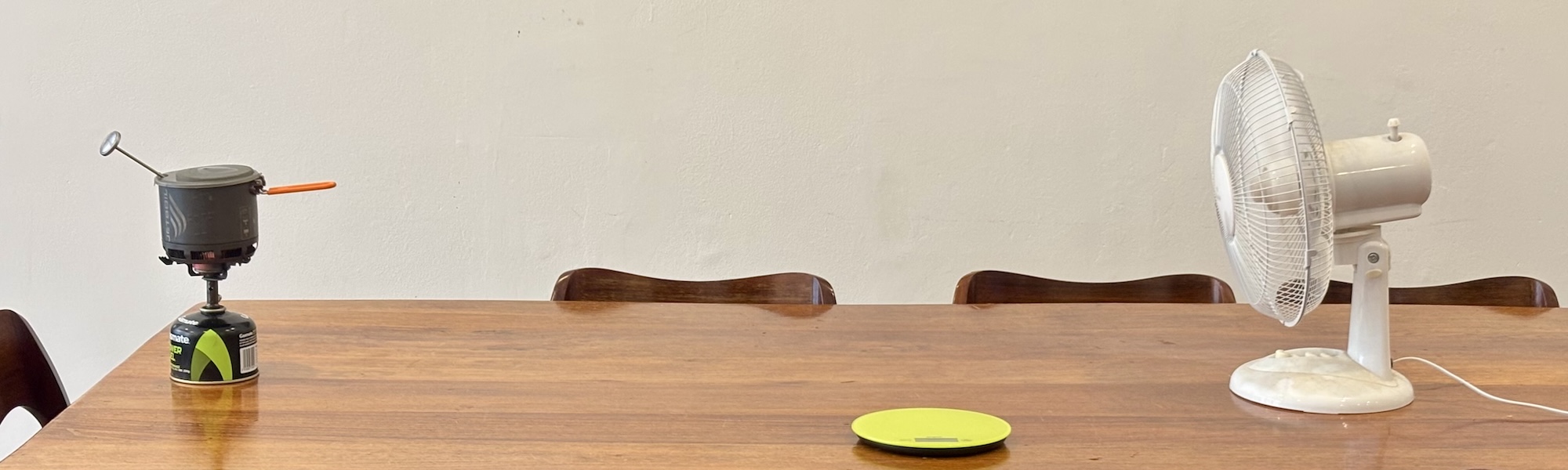
My test looks agricultural in comparison with the finesse of GearSkeptic but it makes the point well enough. The setup is pictured at the start, the fan was on low with a setback of 1300mm and I used the same positions and flame level for both tests, by screwing off the burner to stop the flame rather than adjusting the setting. I allowed the components and the canister to return to room temperature between tests. The air movement felt like a gentle breeze to me.
Obviously, in real life I would take further steps to reduce the airflow around my burner, such as by choosing a protected area in which to cook. But the ‘gentle breeze’ I tested would be the same as a strong wind in a semi-sheltered area.
Here are pictures of the flame in each test. My results follow.
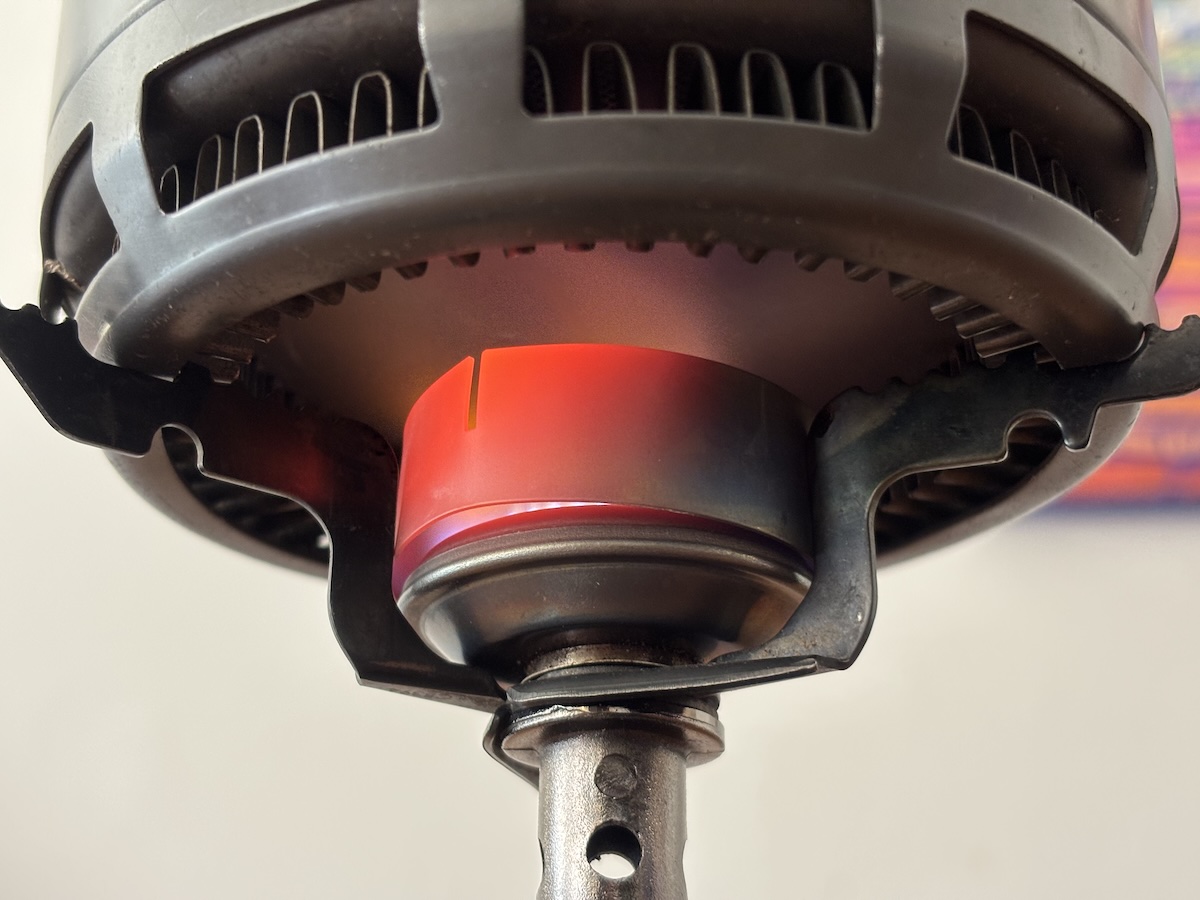
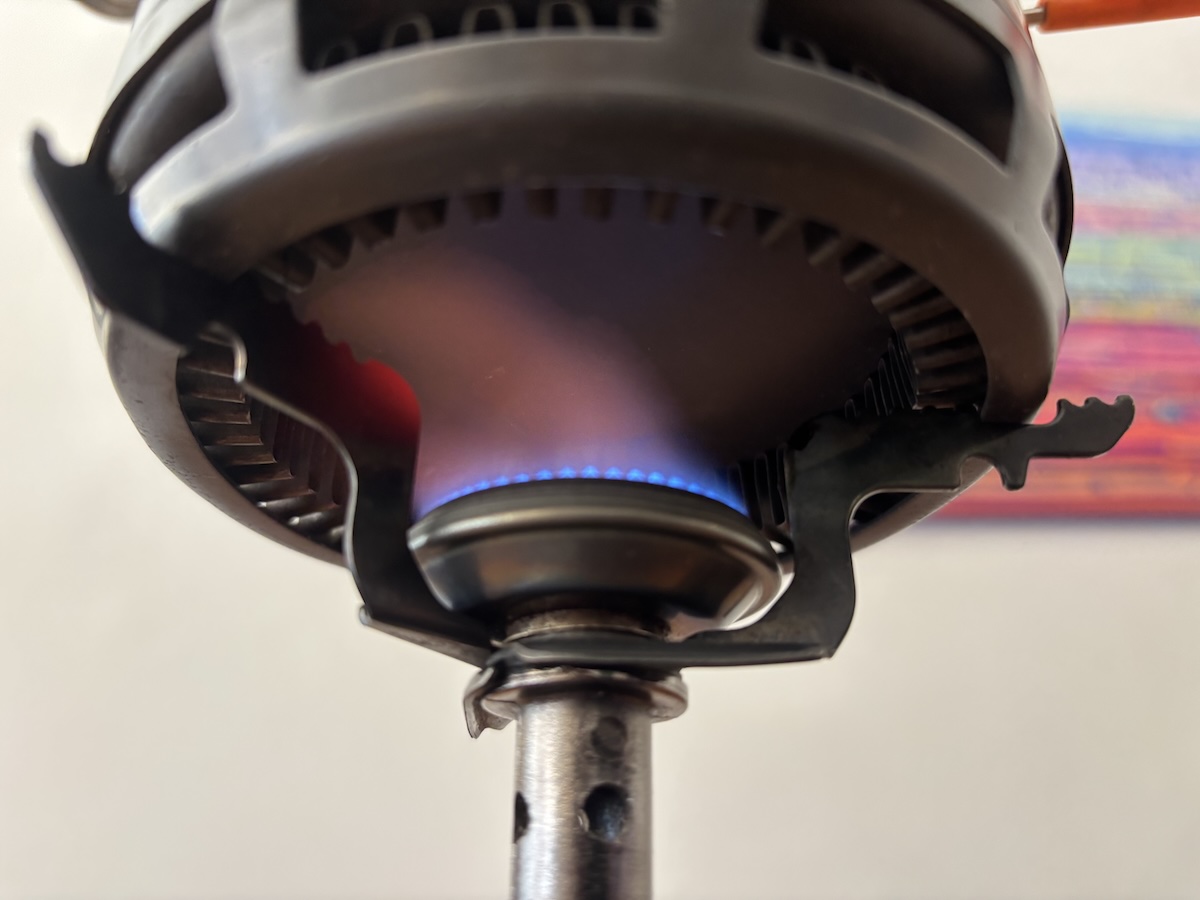
| JetBoil Stash Wind Test | With Wind Shield | Without Wind Shield |
| Time to 92°C | 6min 34s | never (stopped at 66°C after 13 minutes) |
| Time to 96°C | 7min 25s | – |
If you see something that makes you ask questions about your setup in the same way I did, I encourage you to run a controlled trial. It’s easy and fun, and you’re likely to settle the issue without a shadow of doubt before your next trip. The certainty alone is worth it.
And one more thing: the windshield I added weighs 6 GRAMS! Thanks, GearSkeptic 🙂
Comments (0)